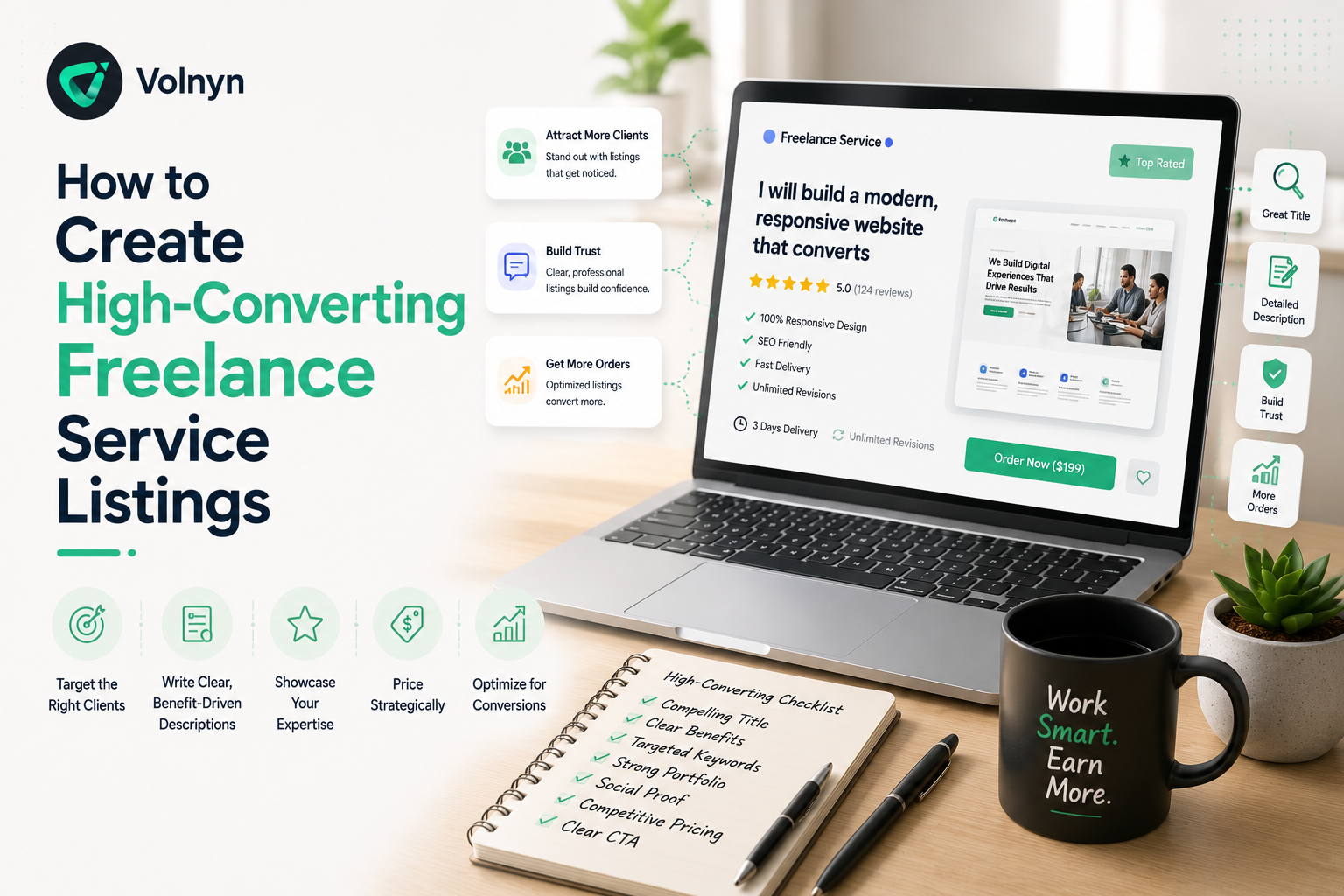
Ideal titles are brief and to-the-point. They call the service: the deliverable, or the problem solved. It's more of a straightforward claim than "Creative branding solutions for modern businesses". The first one tells you exactly what you're getting. The second may refer to anything almost.
Do not use titles that start with your credentials ("Experienced designer with 10 years of industry experience") or how you make your product ("I take a proven approach to creating"). Most clients aren't interested in the process – they're only interested in the result. Write the result in the title.
Write a description that talks to the client, not about yourself
The majority of freelance descriptions are CV-type descriptions. They state their qualifications, tools used, years of experience and past positions. But that information is not irrelevant — but it's not a good idea to lead with it, because you're answering the wrong question first.
One of the first questions a client will ask is if you understand the issue. They don't want to hear about your history, they want to hear about their situation. Begin the description with the client — what they're experiencing, what they need, what a successful outcome would be. Explain how you provide that.
This doesn't mean ignoring your credentials. It means that you have to prove that you are solving the right problem, in order to be able to present that problem. A client who feels understood reads the rest of the listing. If a client feels he/she is reading a CV, it is on to the next person.
Avoid using jargon or specialized terms. The description should not contain industry jargon, long sentences, or flattery. The use of short paragraphs, direct language, and clear structure lends it to easy readability — and easy reading equals more readers.
Be specific about what's included
Fuzzy listings result in indecisive clients. If the prospective customer is unable to tell exactly what they are buying for the price, they are not going to contact you, or if they do, it will be to seek clarification which adds friction and lowers conversion rates.
Be explicit. If you provide website design service, tell clients how many pages, rounds of revision, what's included in the handoff, how many days you are going to take, etc. etc. and what isn't included. When you are selling writing and translation services, let the client know word limits, number of revisions, format of the product and if you include research.
The sharper you can be that you have a well-defined scope, the less wrangling there will be before a client agrees. It also weeds out out of touch clients who have an expectation that you are not able to meet — saving time for both parties.
If you have more than one tier (e.g., basic, standard, and premium), be specific about the differences. The phrase more comprehensive is a non differentiator. Includes three pages vs. one page is.
Price with confidence, not with apology
Underpricing is a common mistake, especially among freelancers who are new to a marketplace. It feels like a way to compete, but it usually signals lack of confidence rather than value. Clients who are looking for quality don't always gravitate toward the cheapest option — they gravitate toward the listing that makes them feel most certain about the outcome.
Price your service based on what the work is worth, not on what you think someone might accept. If you're unsure, look at what comparable listings in your category are charging on Volnyn. Use that as a reference point, not a ceiling.
Explain your pricing briefly if the number needs context. If you charge more than the average in your category because you deliver faster, because you include more, or because your experience commands it — say so. A client who understands why your price is what it is makes the decision more easily than one who's left to guess.
Use your portfolio as proof, not decoration
A portfolio section that exists but contains generic or low-quality samples does more harm than good. It tells the client you have a portfolio but doesn't give them confidence in your work. If your portfolio isn't strong yet, it's better to be selective than to fill space for the sake of it.
Choose samples that are directly relevant to what you're offering. If your listing is for website development, include websites you've built — not general design work, not unrelated projects. If your listing is for digital marketing, show campaigns, results, or examples of strategy documents rather than general marketing collateral.
If you're new and don't have client work to show, create relevant samples specifically for your portfolio. A well-executed speculative project is more convincing than nothing, and more honest than repurposing unrelated work.
Where possible, add context to your samples. What was the brief? What problem did it solve? What was the result? A portfolio piece with a sentence of context is more persuasive than the same piece without one.
Pick the right category for your listing
Category placement affects who sees your listing. A service listed in the wrong category reaches the wrong audience — or a smaller one. Getting this right is a basic step that's worth taking seriously.
Volnyn's freelancing marketplace has specific categories for design and creative work, website design, mobile app development, customer service, research, and more. Each category attracts a different type of client with different needs and different search behavior.
If your service spans more than one category — a freelancer who does both writing and translation, for example — consider whether it makes more sense to list them separately. A single listing that tries to cover too much can dilute its relevance for the clients most likely to need each specific service.
Optimize for the words clients actually search
Clients searching for freelancers use specific terms — usually the name of what they need, not a description of the skill. "Logo design," "product description writer," "React developer," "social media manager" — concrete, functional phrases that describe the output they're looking for.
Include those terms in your title, your description, and your tags if the platform supports them. Not stuffed in artificially — woven in naturally where they fit. The goal is for your listing to appear when someone searches for what you do, not to rank for every possible term at the expense of readability.
Browse the all services listings on Volnyn to see how other freelancers in your field describe their work. Note the language that appears consistently across high-performing listings. That language is there because it's what clients search for — and incorporating it into your listing, in your own voice, puts you in front of the right searches.
Keep your listing current
A listing that hasn't been touched in months gives the impression that the freelancer may not be active. Clients on a marketplace are looking for someone available and responsive — an outdated listing raises doubt about both.
Review your listing every few weeks. Update the description if your service has evolved. Refresh the portfolio if you've done better work since the last update. Adjust pricing if your rate has changed. Small updates signal that the listing is current and the person behind it is engaged.
If you've received feedback from past clients — whether formal reviews or informal comments — use it to improve the listing. If multiple clients have asked the same clarifying question before committing, add the answer to the description. If clients frequently mention a specific strength, make sure that strength is visible in the listing, not buried or missing entirely.
Final Thoughts
A high-converting freelance listing isn't the result of a clever formula. It's the result of being clear about what you offer, honest about what's included, and specific enough that the right clients immediately recognize you as the right person for the job.
Most listings fail because they're written for the freelancer rather than the client — leading with credentials, speaking in abstractions, and leaving the client to do work that the listing should do for them. Reversing that approach, even partially, makes a measurable difference in how many inquiries you receive and how qualified those inquiries tend to be.
Build your listing on Volnyn's freelancing marketplace and apply these habits from the start. The difference between a listing that gets passed over and one that converts is almost always in the details — and the details are entirely within your control.
Frequently Asked Questions
1. How long should my freelance service listing description be?
Long enough to answer the client's main questions, short enough that they actually read it. For most services, two to four short paragraphs is the right range. Lead with what the client gets, follow with how you work and what's included, and close with a line that makes it easy for them to take the next step. Anything longer than that needs to earn its length — every paragraph should serve a purpose.
2. Should I list one broad service or multiple specific ones?
Multiple specific listings generally perform better than one broad one. A client looking for a logo designer isn't searching the same terms as a client looking for a social media kit — even if you offer both. Separate listings let each service speak directly to the right audience, use the right keywords, and show relevant portfolio samples. The extra setup time is worth it.
3. How do I get my first client on Volnyn if I have no reviews yet?
Compensate for the absence of reviews with a stronger listing. A clear, specific description that demonstrates you understand the client's problem, a portfolio with relevant samples — even speculative ones — and transparent, well-explained pricing all build confidence in the absence of a review history. Pricing competitively for your first few projects to secure initial clients and reviews is a reasonable strategy, provided you're not pricing so low that it signals a lack of confidence.
4. How important are tags and keywords in a freelance listing?
They matter because they affect how searchable your listing is. Clients search for specific terms — usually the name of what they need. Including those terms naturally in your title and description, and in any tag fields the platform offers, improves the likelihood that your listing appears in relevant searches. The key word is naturally — keyword-stuffed descriptions are hard to read and put off the clients who do find you.
5. What should I do when my listing has views but no inquiries?
Views without inquiries usually mean something in the listing is creating doubt or confusion after the initial click. Common causes: a description that doesn't clearly explain what's included, pricing that feels high relative to what the listing communicates, a portfolio that doesn't match the service being offered, or a title that attracted the wrong type of visitor. Go through the listing as a potential client would and identify where the hesitation might be coming from. Usually one or two specific changes — clearer scope, better samples, adjusted pricing explanation — make a noticeable difference.