
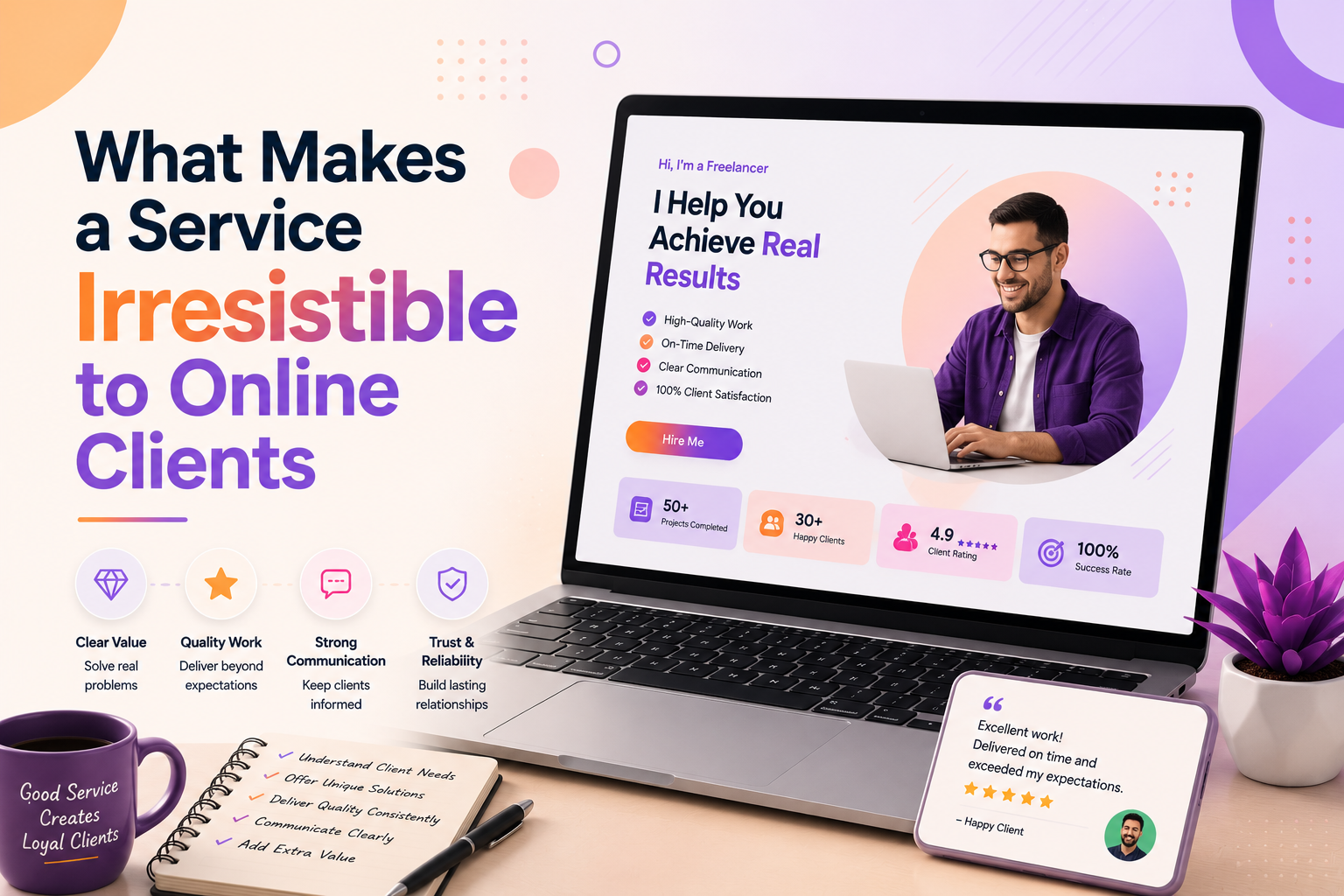
Online clients have more choices than ever. On any freelancing marketplace, a client looking for a designer, a writer, or a developer will find dozens of options within the first minute of searching. Most of those options look broadly similar — similar claims, similar pricing, similar generic descriptions of what the freelancer does. The ones that stand out aren't always the most experienced. They're the ones that communicate something specific, credible, and useful before the client has to ask. Here's what that actually requires.
Why most freelance services fail to convert
The gap between a freelancer's actual skill and their ability to attract clients is real and common. Many capable people lose work to less capable ones simply because the other person's service was easier to understand, more clearly scoped, or felt less risky to hire.
Online clients — particularly those browsing a marketplace — are making fast judgments based on limited information. They're comparing multiple options simultaneously, skimming rather than reading carefully, and looking for reasons to feel confident rather than reasons to keep searching. A service that doesn't quickly answer "what do I get, and why should I trust you with it" gets passed over for one that does.
The irresistible service isn't always the cheapest, or the one with the most impressive credentials. It's usually the one that removes the most uncertainty from the client's decision. Everything else — positioning, copy, pricing, portfolio — is in service of that goal.
Specificity is the most underused advantage
Generic services are forgettable. Specific services are memorable and easier to say yes to.
A freelancer who offers "graphic design" is competing with every other graphic designer on the platform. A freelancer who offers "brand identity design for independent food and beverage businesses" is competing with a much smaller group — and speaking directly to a much more defined client. That client recognizes themselves in the description and immediately feels like this person understands their situation.
Specificity works at every level of a service listing. The category, the title, the description, the examples of past work — all of it becomes more powerful when it's pointed at a particular type of client with a particular type of problem. Breadth feels safe to the freelancer but creates friction for the client. Specificity creates the opposite: a client who sees themselves in your description has less work to do before deciding to reach out.
This doesn't mean turning away anyone who doesn't fit your niche exactly. It means leading with your strongest, clearest positioning and letting clients who fit that description find you more easily.
Clients buy outcomes, not services

The single most common mistake in freelance service descriptions is describing what you do rather than what the client gets.
"I provide SEO copywriting services using proven techniques" describes you. "Copy that ranks in search results and converts readers into enquiries" describes what the client walks away with. These are very different things to read as a potential buyer.
Clients don't hire services — they hire results. They're trying to solve a problem or reach a goal, and the service is the vehicle for that. The freelancers who communicate their offering in terms of client outcomes rather than their own process or credentials speak the language clients are actually using when they search for help.
Reframe every part of your service description through this lens. What problem does this solve? What does the client's situation look like after the work is done? What can they do, have, or show that they couldn't before? Those are the questions your service listing should answer — not "what tools do you use" or "how many years of experience do you have."
Trust signals that actually work
Trust is the central purchase decision in freelancing. The client is handing over money and a degree of control to someone they've never met, usually for work they can't fully evaluate until it's delivered. Every part of your service presentation either adds to that trust or subtracts from it.
The trust signals that work aren't always the obvious ones. Five-star reviews help, but a new freelancer without reviews can still build trust through specificity, transparent scope, a strong portfolio, and clear communication in early messages. A profile that looks carefully put together — professional photo, coherent description, relevant work samples — signals professionalism even before the client has read a word.
Transparency is underrated as a trust signal. Stating clearly what's included, what isn't, how many revisions are covered, and what happens if a client needs something outside the original scope removes the uncertainty that makes clients hesitate. A client who knows exactly what they're getting into is more likely to commit than one who's left guessing.
Responding promptly to initial enquiries is also a trust signal — often more significant than people realize. A freelancer who responds within a few hours signals that they're engaged and professional. One who takes days communicates the opposite, regardless of how good their work actually is.
Pricing that communicates value
Price is a signal, not just a number. Pricing too low doesn't make a service more attractive — it often makes it look less credible. A client evaluating multiple options uses price as one proxy for quality, especially when they can't directly evaluate the work before hiring. A noticeably underpriced service raises questions rather than converting faster.
Set prices based on what the work is worth and what comparable services in your category charge. If you're charging more than the average in your space, have a reason visible in the listing — a tighter turnaround, more included in the scope, more relevant experience for the specific problem the client has. A higher price that comes with clear justification is often preferred over a lower price with no explanation.
Multi-tier pricing — basic, standard, premium — works well when the differences between tiers are concrete and meaningful. The client should be able to look at the tiers and immediately understand what they're deciding between. "More comprehensive" isn't a differentiator. "Includes five pages vs one page, with a revision round vs without" is.
The role of clarity in making a service feel easy to hire
Friction is the enemy of conversion. Every step that requires a client to do more work — to ask a clarifying question, to figure out what's included, to guess at the timeline — is a step at which they might decide it's not worth the effort and move to the next listing.
A service that's easy to hire answers all the basic questions before the client has to ask them. What do I get? How long does it take? How many revisions are included? What format will the deliverables be in? What do you need from me to start? A listing that covers these clearly converts better than one that's more impressive on paper but requires the client to work for the information.
Think about the questions you get asked most often before a client commits. Those are the gaps in your current listing — the things clients need to know before they feel comfortable proceeding. Each one that you answer in the listing is one fewer barrier between the client and clicking hire.
Category matters more than most freelancers think
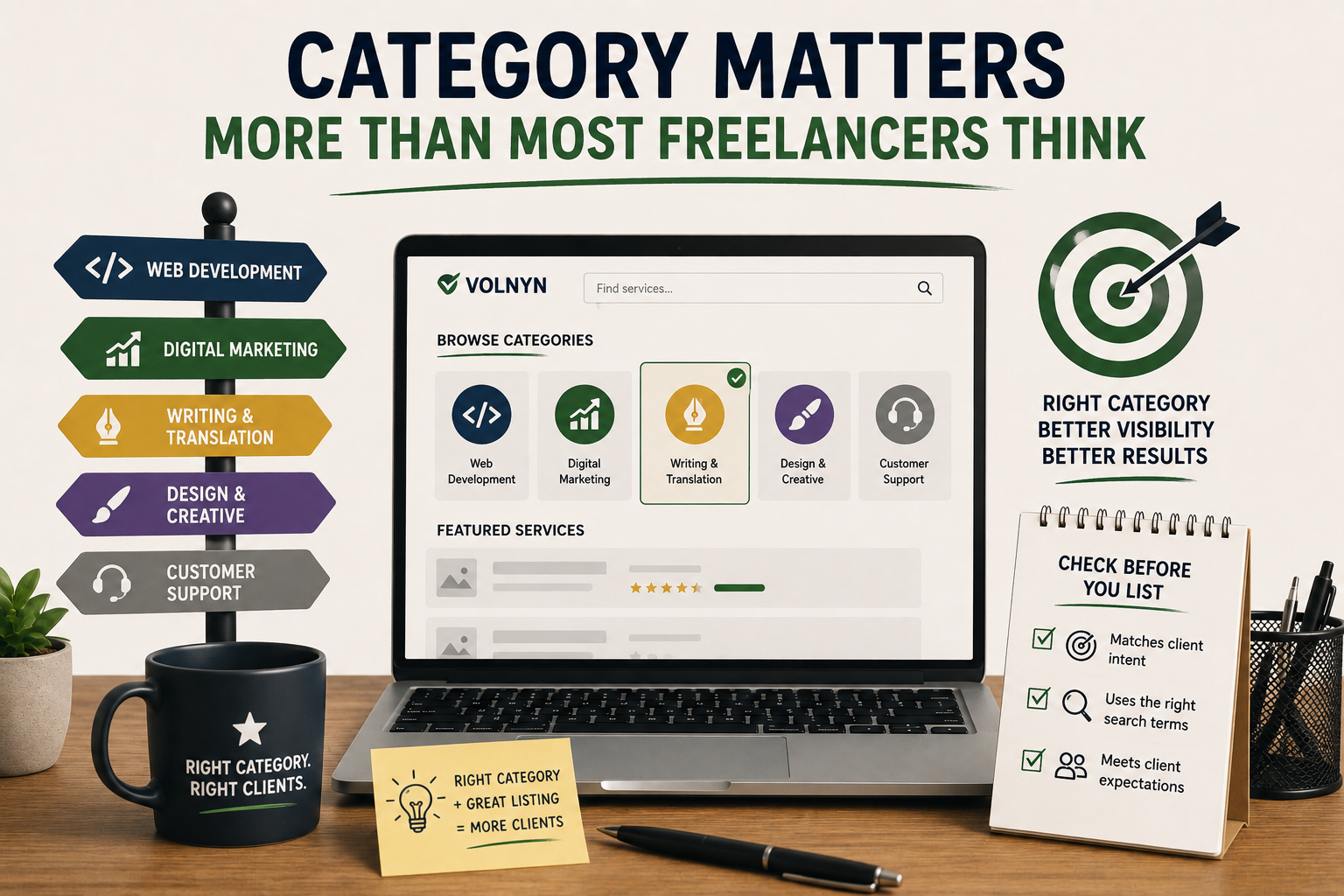
The category you list under determines who sees your service, what search terms surface it, and what client expectations you're entering with. Getting this right is a basic step that has a real effect on how well a service performs.
On Volnyn's freelancing marketplace, services are organized into specific categories that clients browse by intent. A client looking to hire someone for website development is in a different mindset and looking for different things than a client browsing digital marketing services or design and creative work. Each category has its own language, its own trust signals, and its own client expectations.
A writing and translation service listed under the wrong category reaches an audience that wasn't looking for it. A mobile app development service that's correctly categorized but poorly described misses the clients it could have reached. Both the category and the listing need to work together.
If your service genuinely spans more than one category — a freelancer who does both website design and customer service support, for example — consider whether separate listings would serve you better than trying to cover both in one. A listing that tries to be too many things dilutes its relevance for each individual client it's trying to reach.
How to apply this on Volnyn
Everything in this article is directly applicable to how you present yourself on Volnyn's freelancing platform. The marketplace is where clients searching for specific services find freelancers — which means your listing is your first impression, your pitch, and your credibility signal all at once.
Browse the full services listing to see how other freelancers in your field are presenting their work. Note the language that appears consistently across well-performing listings. That language exists because it matches what clients search for and what they respond to. Incorporating it into your own listing — in your own voice, with your own specific positioning — puts you in front of the right searches.
Then apply the principles here one at a time. Sharpen the title to describe the outcome rather than the skill. Rewrite the description from the client's perspective. Add concrete scope details. Update the portfolio to show only the work most relevant to the clients you want to attract. Test whether the listing answers the questions a client would ask before committing — and fill in the gaps if it doesn't.
A listing built this way doesn't just attract more clients. It attracts better-fit clients — the ones whose expectations match what you're offering, which makes the work better and the relationship easier from the start.
Final Thoughts
An irresistible freelance service isn't one that promises more than everyone else. It's one that makes a specific client feel understood, removes the uncertainty from their decision, and makes hiring you feel like the obvious next step rather than a risk.
That requires specificity over breadth, outcome-focused language over process descriptions, and clarity over comprehensiveness. None of it is complicated. Most of it just requires looking at your service from the client's perspective — which most freelancers don't do nearly often enough.
Apply even one or two of these principles to your current listing and measure what changes. Then keep going. The best-performing freelance services on any platform aren't static — they're refined over time by people who pay attention to what's working and adjust accordingly.
Frequently Asked Questions
1. How specific should my freelance service niche be?
Specific enough that the right client immediately recognizes themselves in it. A niche that's too broad reaches everyone and resonates with no one. A niche that's too narrow limits your potential client pool unnecessarily. The right level is usually one where you can describe a particular type of client with a particular type of problem — and where that description is true of the clients you actually want to work with. Start narrower than feels comfortable. You can always broaden later, but a focused listing almost always outperforms a general one in the early stages.
2. What should I do if I have no reviews yet on Volnyn?
Compensate with everything else. A highly specific, well-written listing with a relevant portfolio and transparent scope signals professionalism even without a review history. Consider pricing competitively for your first few projects to lower the barrier for early clients — not so low that it undermines your credibility, but enough to make the decision easier for someone taking a chance on a new profile. Once you have two or three positive reviews, the rest of the listing does more of the work.
3. How often should I update my freelance service listing?
Whenever something meaningful changes — your pricing, your availability, the scope of what's included, or the examples in your portfolio. Beyond that, a monthly review of listings that aren't converting as well as you'd like is a good habit. Look for the gap between views and enquiries — if people are finding the listing but not reaching out, something in the listing is creating hesitation. Usually it's an unclear scope, a missing trust signal, or copy that describes you rather than the client's outcome.
4. Is it better to have one broad service listing or multiple specific ones?
Multiple specific listings almost always perform better. A client searching for a logo designer and a client searching for a social media content creator are different people with different needs, using different search terms. One listing trying to address both dilutes its relevance for each. The extra setup time of creating separate listings for each service pays off in how precisely each one speaks to the audience it's targeting.
5. Why do clients sometimes choose a less experienced freelancer over a more experienced one?
Usually because the less experienced freelancer's listing was clearer, more specific, and easier to say yes to. Experience is valuable, but it doesn't communicate itself. A highly experienced freelancer with a vague listing loses to a less experienced one with a precise, client-focused listing because the second one answers the client's questions before they've had to ask them. This is good news: it means positioning and presentation are entirely within your control, regardless of where you are in your freelancing career.