
Introduction
Establishing a strong online presence is more vital than ever for businesses, professionals, and organizations that want to build credibility online. A website can be the first impression a brand makes on its audience, whether the purpose is to attract customers, demonstrate services, collect leads, or share important information.
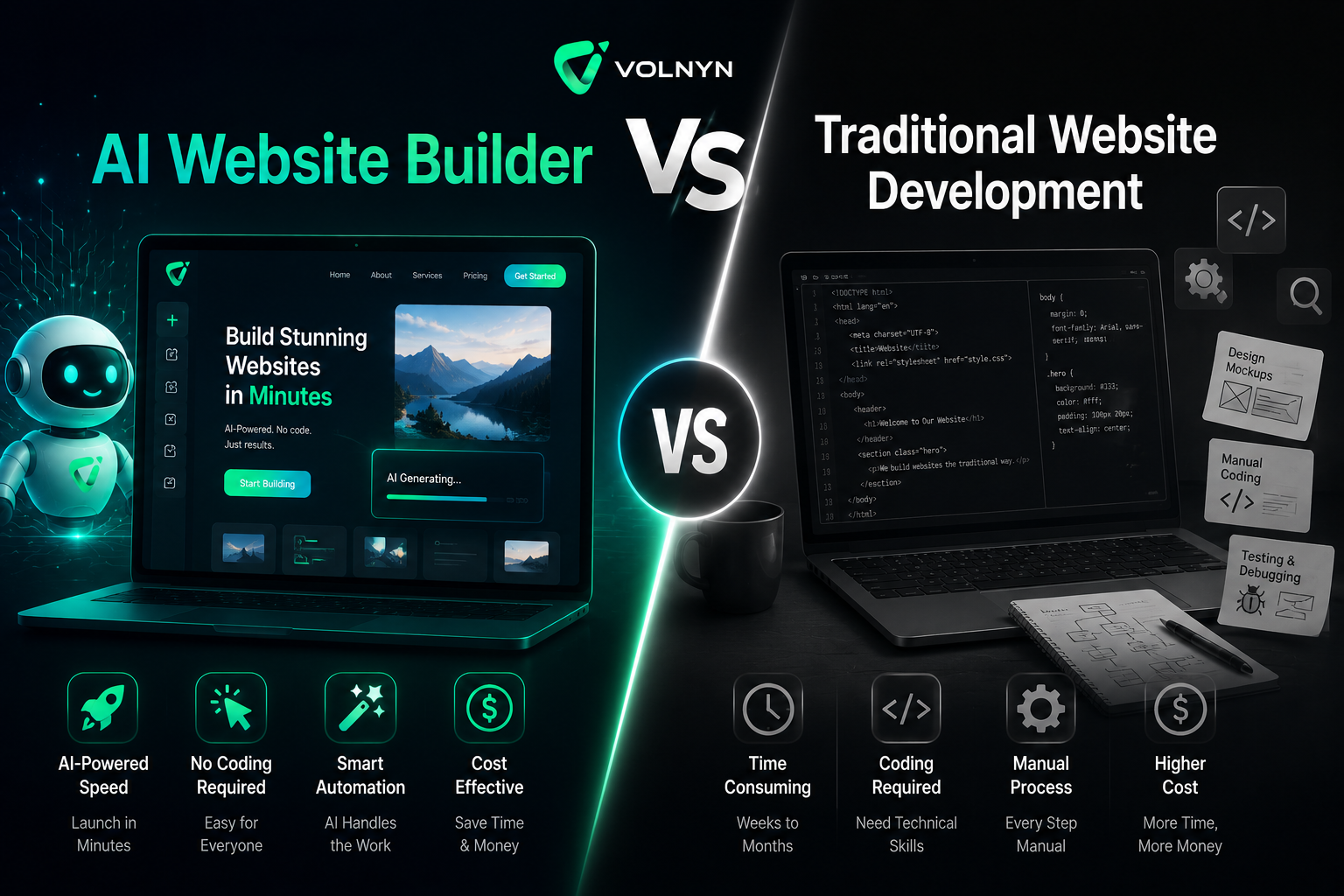
The old method of website development has been the standard for many years. Businesses would collaborate with designers and developers to plan, design, code, test, and deploy a website that meets their exact requirements. This approach is still widely used today, but with the development of artificial intelligence, there is also a newer option: AI website builders.
AI website builders are transforming the website creation process by streamlining many tasks that traditionally required technical skills. Users can create website structures, layouts, and design foundations automatically, rather than building every element from scratch.
While both models are still relevant, many companies now ask the same question: which approach is better? The answer depends on project requirements, budget, customization needs, and long-term goals. Understanding the pros and cons of each approach can help organizations choose the right path for their digital strategy.
Table of Contents
- Understanding Traditional Website Development
- What Is an AI Website Builder?
- Development Speed and Efficiency
- Customization and Creative Freedom
- Cost and Resource Considerations
- Maintenance and Long-Term Management
- Which Approach Fits Different Business Needs?
- The Future of Website Creation
- Final Thoughts
- Frequently Asked Questions
Understanding Traditional Website Development
The traditional way of making a website is by manually designing and developing it. This can involve designers, developers, content creators, project managers, and quality assurance teams collaborating to create a tailored solution.
It typically starts with planning and requirements gathering. The objectives, audience, functionality requirements, and branding expectations are established before development begins. Designers then produce layouts and visual concepts, while developers build the functionality that powers the website.
The flexibility of traditional development is one of its greatest advantages. Almost every part of the website can be tailored to suit a specific business requirement. This level of control is ideal for organizations with complex workflows, advanced integrations, or unique features.
Customization, however, also brings complexity. Timelines can be longer, project costs can be higher, and maintenance may require specialized skills. For some organizations, these factors are justified by the ability to create a highly customized digital experience.
What Is an AI Website Builder?
An AI website builder refers to software that uses artificial intelligence to simplify and speed up the website-building process. Users enter information about their business, goals, industry, and preferences, allowing the system to process the data and generate a website foundation without requiring manual design from the beginning.
The AI then creates a website structure based on those inputs. This can include page layouts, navigation menus, content sections, design recommendations, and other important website elements.
For less technical users, modern AI website builders make website creation more accessible. Users can dedicate more time to content, branding, and business information instead of coding and technical setup.
This is the core idea behind platforms such as Volnyn’s website templates, where users can begin with structured website layouts and customize them according to their needs. Volnyn also supports website enhancement through Volnyn plugins, allowing users to add useful frontend features and interactive elements.
Although AI can streamline the process, it is important to remember that it is meant to support people, not replace strategic planning and human decision-making.
Development Speed and Efficiency
One of the biggest differences between AI website builders and traditional website development is the time required to launch a website.
Standard development initiatives typically follow several phases, such as planning, design reviews, coding, testing, revisions, and deployment. Depending on complexity, these projects can take weeks or even months to complete.
AI website builders can shorten this timeline by automating essential tasks. A user can create a general structure of the website quickly and then adjust it to fit specific requirements.
AI builders can improve efficiency in areas such as:
- Initial website setup
- Layout generation
- Navigation structure creation
- Design recommendations
- Content organization
- Responsive design implementation
AI-driven solutions are especially appealing for startups, small businesses, freelancers, and organizations looking to build their online presence in a timely manner. However, development speed does not automatically mean a better website. Even after launch, a website still needs thoughtful content, clear messaging, and continuous optimization.
Customization and Creative Freedom
Customization is one of the clearest differences between these two approaches. Traditional website development is highly flexible and can be shaped around almost any business requirement. Developers can create unique user experiences, business-specific functionality, custom interfaces, and special integrations.
This degree of control may be preferable for organizations with complex requirements, as it allows them to build exactly what they want. Businesses that need advanced web applications, membership systems, internal dashboards, or custom platforms may still find traditional development more suitable.
In contrast, AI website builders are usually based on structured templates and predefined design systems. Users can still adjust layouts, colors, typography, content, and design details, but they usually work within the framework provided by the platform.
For many businesses, this is not a major limitation. A professional service provider, local business, consultant, personal brand, or portfolio website often does not require heavy custom development. In many cases, the simplest solution can provide the best practical value.
Cost and Resource Considerations
Budget is another important factor when comparing website creation methods. Traditional website development usually includes costs for design, development, testing, revisions, project coordination, and technical support. The more complex the website becomes, the more investment is usually required.
AI website builders typically offer a more straightforward and transparent pricing model. Since many tasks in the development process are automated, users can start a professional website without investing heavily in a fully custom development project.
Internal resources are also worth considering. Traditional development often requires coordination between stakeholders, technical teams, designers, and content creators. With AI-powered platforms, much of this complexity is reduced, making the website creation process more efficient and manageable.
Cost should not be the only factor in decision-making, but it remains important. Businesses should choose an approach based on value, long-term goals, and the level of functionality they actually need.
Maintenance and Long-Term Management
Creating a website is only the beginning of its lifecycle. Regular maintenance is just as important for long-term performance, security, and relevance.
Traditional websites may require regular updates, technical monitoring, performance optimization, security checks, and bug fixes. Depending on the technology stack used, these tasks may require specialized development knowledge.
Most AI website builders simplify maintenance by handling many technical details automatically. Hosting, security updates, platform improvements, and basic system maintenance may be managed behind the scenes.
This allows website owners to focus more on updating content, improving customer communication, and growing the business instead of managing technical administration. Regardless of the development method used, every business should maintain a proper plan for keeping website information accurate, current, and aligned with organizational goals.
Which Approach Fits Different Business Needs?
There is no one-size-fits-all answer when deciding between an AI website builder and traditional website development. The better choice depends on the type of website, available resources, timeline, and future plans.
AI website builders are frequently ideal for:
- Small businesses
- Startups
- Freelancers
- Consultants
- Personal brands
- Service-based businesses
These users usually prioritize speed, simplicity, and cost efficiency. They need a professional website that can be launched and managed without unnecessary technical difficulty.
Traditional website development may be more appropriate for:
- Large enterprises
- Complex web applications
- Custom software platforms
- Advanced membership systems
- Highly specialized digital experiences
For organizations with unique operational needs, custom development can still be the right solution. The final decision should not be based only on technology trends, but on what supports the business both now and in the future.
The Future of Website Creation
In the future, the AI website builder versus traditional website development discussion is unlikely to remain a strict either-or choice.
Many developers are already using AI tools to improve productivity, automate repetitive tasks, and accelerate project timelines. At the same time, AI website builders are becoming more advanced and offering better customization options.
AI is not a complete replacement for the development process. Instead, it is becoming a complementary tool within the broader web development landscape. Businesses can benefit from automation while still relying on human expertise for strategy, branding, and more complex functionality.
As technology continues to evolve, the most successful websites will likely combine intelligent automation with thoughtful human oversight.
Final Thoughts
Both AI website builders and traditional website development offer important advantages. One focuses on speed, accessibility, and simplicity, while the other focuses on flexibility, customization, and full control.
AI-driven website creation is a valuable option for many businesses that do not have extensive technical resources but still need a professional online presence. Traditional development continues to provide strong value for organizations with complex requirements and highly specific digital goals.
The choice should not be made only because a certain method is popular. Businesses should carefully consider their intentions, resources, technical demands, and long-term plans before selecting an approach. When organizations understand the strengths of both methods, they can create websites that support sustainable growth and provide real value to their audience.
Frequently Asked Questions
Can an AI website builder be used for a business website?
Yes. AI website builders can create professional websites for businesses, service providers, consultants, and startups. They are especially useful for companies that want a faster and easier website creation process.
Is there more flexibility in traditional website development?
Yes. Traditional development allows companies to build very specific functionality, custom designs, and advanced integrations that may not be available in standard website-building platforms.
Is an AI website builder faster than traditional website development?
In most cases, yes. AI website builders streamline several parts of the website development process, helping users create and launch websites in less time.
Is it possible to edit a website after creating it with AI?
Absolutely. Most AI website builders provide a user-friendly interface for editing content, updating pages, changing layouts, and making continuous improvements without technical expertise.
Which option is best for a startup?
Many startups choose AI website builders because they offer quicker turnaround and lower initial costs. However, startups with specific product or platform requirements may still benefit from custom development.
Is AI going to replace web developers in the future?
AI is expected to support developers, not replace them completely. Human expertise is still needed for strategy, custom functionality, complex systems, and unique digital experiences.