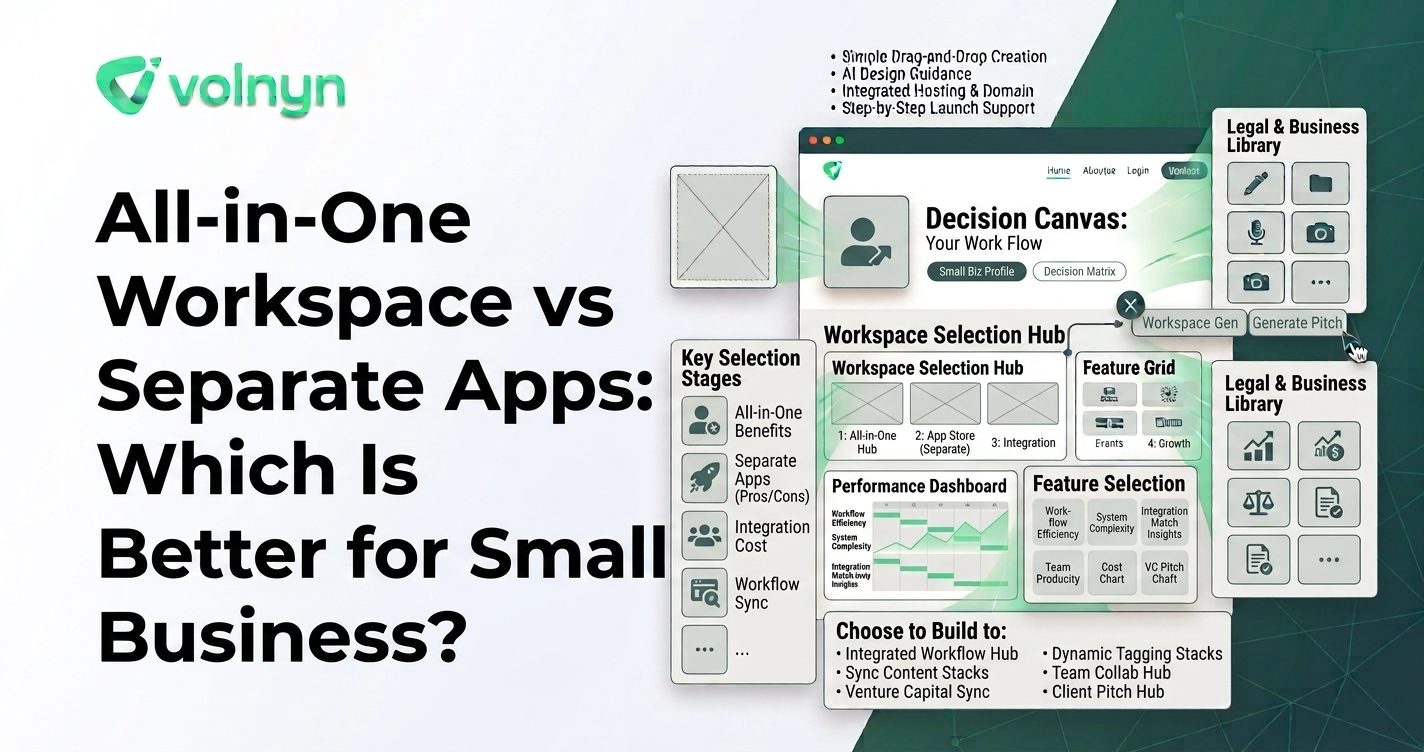
Small businesses rarely use just one digital tool. A typical workflow might involve one application for the website, another for documents, another for presentations, separate storage, and additional services for communication and collaboration.
That approach can work. But as the number of tools grows, so does the work required to keep information organized. An all-in-one workspace takes the opposite approach: bring several related activities into one environment so that information, branding, and workflows stay connected.
The better option depends on how your business works. This guide compares both approaches across productivity, cost, flexibility, information management, and day-to-day operations.
What Is an All-in-One Workspace?
An all-in-one workspace combines multiple business functions inside one platform rather than requiring a separate application for every task.
For example, Volnyn's all-in-one workspace currently brings together an AI website builder, site documents, and AI presentations. The platform describes these as connected assets that can be created and stored within the same account.
The idea is not necessarily to replace every application a business uses. Instead, it is to centralize related work that would otherwise be spread across several services.
What Does Using Separate Apps Look Like?
With separate apps, each job is handled by a specialized service. You might use one platform to build a website, another to write documents, another to create presentations, and another to store or share files.
This approach has an obvious advantage: you can choose the application that is strongest for each individual task.
It can also introduce additional overhead. Every service may have its own account, interface, subscription, file structure, permissions, update cycle, and way of handling information.
The challenge becomes more noticeable when the same business information needs to appear in several places.
All-in-One Workspace vs Separate Apps
| Factor |
All-in-One Workspace |
Separate Apps |
| Tool switching |
Fewer application changes for connected tasks |
More switching between specialized tools |
| Information management |
Related assets can stay together |
Information may be distributed across services |
| Flexibility |
Depends on the platform's capabilities |
High choice across individual applications |
| Subscriptions |
Potentially fewer services to manage |
Each application may have its own plan |
| Learning curve |
One main environment to learn |
Different interfaces and workflows to learn |
| Specialized features |
May be less specialized in individual areas |
Can select highly specialized tools |
The Hidden Cost of Tool Switching
The biggest argument for consolidating tools is not necessarily the number of applications on a screen. It is the amount of context that has to move between them.
Research on workplace productivity has repeatedly examined the effects of interruptions and task switching. Microsoft Research's observational research found that developers viewed uninterrupted progress as an important part of productive work, while observed participants also performed substantial task and activity switching. ([microsoft.com](https://www.microsoft.com/en-us/research/publication/software-developers-perceptions-of-productivity/))
More recent Microsoft Work Trend Index research has also described frequent interruptions, messaging, meetings, and application switching as contributors to fragmented workdays. ([microsoft.com](https://www.microsoft.com/en-us/worklab/work-trend-index/breaking-down-infinite-workday))
This does not mean that every application switch is harmful. Sometimes a specialized tool is exactly what the task requires. The practical question is whether your team is switching tools because each one provides necessary capabilities—or because related work was never organized in one place.
When Separate Apps Are the Better Choice
An all-in-one platform is not automatically the right answer.
Separate apps can make sense when a business needs highly specialized functionality that a unified workspace does not provide. A professional video-production team, for example, may require advanced editing software that is designed specifically for that job.
Specialized applications can also be useful when:
- Your team already has an efficient, established workflow.
- A particular application provides essential capabilities unavailable elsewhere.
- Different departments have substantially different technical requirements.
- You need a specific integration or enterprise feature.
- The benefits of specialization clearly outweigh the management overhead.
The goal should not be to eliminate tools simply for the sake of having fewer tools.
When an All-in-One Workspace Makes More Sense
Centralization becomes more attractive when several activities revolve around the same business information.
Consider a small company preparing for a product launch. It may need a website, supporting documents, product information, and a presentation for potential customers or partners.
If those assets are created separately, the same company description, product details, brand colors, images, and messaging may need to be copied between applications.
Volnyn's workspace is designed around this type of connected workflow. Its current product page says websites, site documents, and presentations can live in the same account, with business details and branding reused across related work. ([volnyn.com](https://volnyn.com/all-in-one-workspace))
For a small team without dedicated IT or operations staff, reducing this administrative overhead can be particularly useful.
Cost: Count More Than Subscriptions
Separate applications can create several layers of cost.
There is the obvious subscription cost, but businesses should also consider the time spent administering accounts, managing renewals, moving files, maintaining integrations, teaching employees different interfaces, and resolving inconsistencies between tools.
Atlassian has similarly noted that uncontrolled application growth can contribute to redundant tooling, additional costs, and administrative strain. ([atlassian.com](https://www.atlassian.com/blog/leadership/4-common-barriers-to-team-productivity))
An all-in-one workspace can simplify this side of the equation when the included tools genuinely cover the business's needs. But compare the actual capabilities and pricing rather than assuming that consolidation is always cheaper.
Information Consistency Matters
One of the less obvious advantages of connected tools is maintaining consistent information.
Imagine that your company changes its service description. If the website, presentation, sales document, and other materials are maintained independently, someone needs to remember where that information appears.
When related assets share a workspace or source of information, updating one piece of business information can be easier to coordinate across the rest of the workflow.
Volnyn specifically positions its workspace around this concept, describing the website, site docs, and presentations as sharing a source of truth rather than requiring repeated copy-and-paste between disconnected applications. ([volnyn.com](https://volnyn.com/all-in-one-workspace))
Flexibility vs Simplicity
This is the most important trade-off to understand.
Separate apps maximize choice. You can select a specialized tool for nearly every task.
An all-in-one workspace maximizes consolidation. You accept one platform's capabilities in exchange for having related work in one environment.
Neither principle is universally better. The right balance depends on whether your business values specialization or simplicity more for the workflow in question.
How to Decide Which Approach You Need
Start by auditing your current workflow rather than counting applications.
- List your recurring tasks. Include websites, documents, presentations, content, design, communication, and other regular activities.
- Map where each task happens. Record the application, login, files, and people involved.
- Identify repeated information. Look for business details, branding, product descriptions, images, and other content that is repeatedly copied.
- Measure the friction. Note where people lose time switching tools, searching for files, or recreating information.
- Identify essential specialized tools. Keep applications that provide capabilities your business genuinely cannot replace.
- Consolidate where it helps. Move connected workflows into a shared environment when doing so reduces complexity without sacrificing essential functionality.
Volnyn's Approach to the All-in-One Model
Volnyn is built specifically around consolidating several digital-business workflows. Its current all-in-one workspace includes an AI website builder, site documents, and an AI presentation generator, with those assets stored within the same account. ([volnyn.com](https://volnyn.com/all-in-one-workspace))
The website builder can generate a starting website from a business description, while the workspace can also be used for supporting documents and presentations. This makes the platform relevant when those outputs belong to the same business project rather than existing as completely independent tasks.
You can explore Volnyn's all-in-one workspace to see how the connected workflow works.
A Hybrid Approach Can Work Too
Choosing between an all-in-one workspace and separate apps does not have to be an all-or-nothing decision.
A small business can centralize its core workflow while retaining specialized tools where they provide clear value. For example, a company could use an all-in-one workspace for its website, business documents, and presentations while keeping a specialized accounting, video-editing, or customer-support platform.
The goal is not the smallest possible app count. It is a workflow in which every tool has a clear purpose and the cost of moving information between them is justified.
Conclusion
An all-in-one workspace and a collection of separate apps solve different problems.
Separate applications give businesses maximum choice and access to specialized functionality. An all-in-one workspace can reduce tool switching, simplify administration, keep related information together, and make it easier to maintain consistent business content.
For small businesses, the best approach is usually the one that reduces unnecessary complexity without removing capabilities the business actually needs. Audit your workflow, identify where information is repeatedly moved between applications, and decide whether those handoffs are creating enough friction to justify consolidation.
If website creation, documents, and presentations are central to your workflow, Volnyn's all-in-one workspace provides one way to bring those activities together instead of managing them across separate platforms.