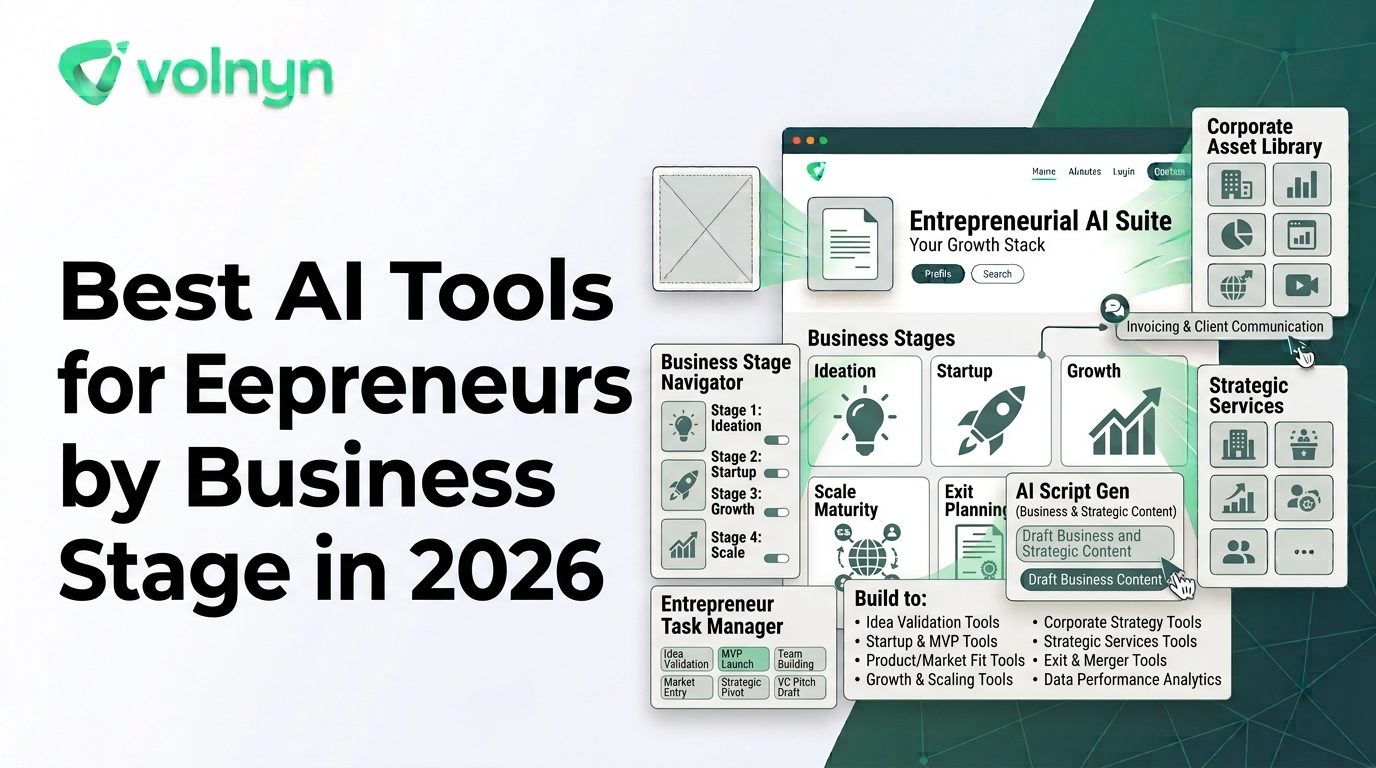
Entrepreneurs rarely need AI for just one job. A founder may research a market in the morning, write a landing page at noon, prepare a sales presentation in the afternoon, and automate repetitive tasks before the day ends. The challenge is not finding more AI tools. It is choosing the right tools for the stage your business is actually in.
This guide takes a practical approach to the best AI tools for entrepreneurs in 2026, organizing them by business stage and the problems they can solve. Instead of building a huge software stack, you can start with the tools that address your biggest bottleneck and add others only when they create measurable value.
Why Entrepreneurs Should Choose AI Tools by Business Stage
AI can support research, content creation, customer communication, data analysis, repetitive tasks, and brainstorming. The U.S. Small Business Administration recommends that small businesses start small, test whether an AI tool actually adds value, and consider risks such as security, intellectual property, and accuracy.
That makes a workflow-based approach more useful than simply collecting popular AI applications. A tool that is valuable during idea validation may be less important once your business is dealing with hundreds of leads or customers.
Best AI Tools for the Idea and Validation Stage
ChatGPT for Research, Brainstorming, and Planning
When you are still testing an idea, a general-purpose AI assistant can help turn an unclear concept into a structured research process. ChatGPT can help entrepreneurs brainstorm business models, develop customer interview questions, organize market research, compare alternatives, draft business plans, and analyze information.
OpenAI's current research guidance describes ChatGPT as a tool for gathering and synthesizing information, comparing sources, and producing structured reports with citations. That makes it useful for initial exploration, provided important claims are checked against reliable sources.
The key is to use AI as a research assistant rather than treating its first answer as proof that an idea will succeed. Validate assumptions with customers, market evidence, competitors, and real-world testing.
Best AI Tools for Launching a Business
Volnyn for Your Website and Business Assets
Once an idea is ready to launch, entrepreneurs often need a website, supporting documents, and presentations at the same time. Volnyn's current platform combines an AI website builder with documents and AI presentations in its broader workspace.
Its AI website builder lets users describe a business and generate a starting website with content, structure, and design. The platform also provides visual editing, hosting, mobile responsiveness, and an SEO-friendly structure, according to its current product information.
For an entrepreneur, the practical benefit is reducing the number of separate steps between an idea and a usable online presence. You can start with the website, refine the content, and create supporting business materials without building every asset from scratch.
Canva for Visual Marketing Assets
Branding and marketing usually require more than written copy. Canva's AI-powered Magic Studio includes tools for creating and editing visual content, generating first drafts, and producing presentations and other business materials.
This can be useful during launch when you need social graphics, promotional visuals, presentations, or other branded assets quickly. Human review still matters: check brand consistency, factual claims, images, typography, and messaging before publishing.
Best AI Tools for Early-Stage Operations
Notion AI for Business Knowledge and Projects
As a business grows, information becomes harder to manage. Customer feedback may sit in one place, meeting notes in another, and project plans somewhere else. Notion combines documents, tasks, databases, and knowledge management, while its AI features can help teams work with that information.
This makes it useful for entrepreneurs who are moving from an informal collection of notes to a more structured operating system. Use it for project planning, internal documentation, meeting summaries, product information, and recurring processes.
Zapier for Repetitive Workflows
Automation becomes valuable when the same administrative task happens repeatedly. Zapier connects business applications and supports AI-powered workflows, allowing entrepreneurs to automate processes that would otherwise require manual copying, sorting, notifications, or data entry.
For example, a new lead could trigger a workflow that records the contact, categorizes the inquiry, creates a follow-up task, and notifies the right person. The exact workflow will depend on the systems your business already uses, but the principle is simple: automate a repeatable process only after you understand how it should work.
Match Your AI Stack to Your Business Stage
| Business Stage |
Primary Need |
Useful AI Capability |
| Idea and validation |
Understand the opportunity |
Research, brainstorming, analysis, and planning |
| Launch |
Create a professional presence |
Website creation, branding, presentations, and content |
| Early growth |
Organize work and communication |
Knowledge management, project support, and content workflows |
| Scaling |
Reduce repetitive operations |
Automation, integrations, reporting, and structured workflows |
How to Build a Practical AI Stack
You do not need a dozen subscriptions to benefit from AI. A smaller stack can be easier to manage, cheaper to maintain, and simpler for a team to adopt.
- Identify the bottleneck. Find the recurring task that consumes meaningful time or slows down an important business process.
- Choose one suitable tool. Start with the simplest option that addresses the problem rather than adding several tools at once.
- Test it on real work. Use an actual business task so you can judge the quality and usefulness of the output.
- Create a repeatable workflow. If the experiment works, document how the tool should be used and reviewed.
- Keep human approval. Review customer-facing content, financial information, legal material, strategic decisions, and other high-impact outputs.
- Measure the result. Look at time saved, output quality, cost, or another meaningful business metric.
Common Mistakes Entrepreneurs Make With AI
The biggest mistake is treating AI adoption as a software-collection exercise. Adding another tool does not automatically improve a business. Every application creates some combination of cost, training requirements, security considerations, and workflow complexity.
Another problem is trusting generated information without verification. AI can produce useful drafts while still making factual errors or overlooking important context. The SBA also recommends reviewing AI-generated outputs and being careful with sensitive or proprietary information.
Entrepreneurs should also avoid automating a broken process. If a workflow is confusing when handled manually, adding AI may simply make the same confusion happen faster. First simplify the process, then automate the parts that are genuinely repetitive.
Where Volnyn Fits Into an Entrepreneur's AI Stack
Volnyn is particularly relevant when the challenge is turning a business idea into a professional digital presence. Its current all-in-one workspace brings websites, site documents, and presentations together, while its AI workspace also supports creating digital projects such as websites, presentations, images, and games.
That makes Volnyn a practical option when an entrepreneur wants to reduce the number of separate tools involved in launching and presenting a business. Rather than adding another application simply because it uses AI, the goal is to consolidate useful work around the assets the business actually needs.
Conclusion
The best AI tools for entrepreneurs depend on what the business needs next. During idea validation, research and planning tools can help clarify the opportunity. During launch, website and design tools can reduce the work required to establish a professional presence. As the business grows, knowledge-management and automation tools can help organize operations and reduce repetitive work.
The most practical approach is to start with one clear problem, test one tool against a real workflow, and keep it only if it creates measurable value. AI works best as an extension of entrepreneurial judgment—not a replacement for it.