An AI website can be generated in minutes, but a finished website is not automatically a good website. The difference is what happens after the initial generation: whether the pages have a clear purpose, the content is useful, the design guides visitors, and the site works well across devices.A useful way to judge an AI-generated website is to look at its anatomy. Instead of asking whether it “looks professional,” examine the individual parts that make the experience work. Here are the essential components to check before publishing.
1. A Clear Purpose and Audience
Every strong website begins with a simple question: what should this website help the visitor do?
A business site might be designed to generate inquiries. A portfolio may need to showcase work and encourage prospective clients to get in touch. An online store has a different job: helping people understand products and complete purchases.
An AI-generated website can produce attractive sections without fully understanding the business objective. Check the homepage and ask whether a first-time visitor can quickly understand what the business offers, who it serves, and what action to take next.
If the answer is unclear, the problem is structural rather than cosmetic.
2. Information Architecture That Makes Sense
A good website has a logical relationship between its pages and sections. Visitors should not have to guess where to find services, pricing, company information, products, contact details, or supporting content.
Look for:
- A navigation menu with clear, useful labels.
- A homepage that introduces the most important information first.
- Pages organized around real visitor needs rather than arbitrary sections.
- Calls to action that appear where visitors are likely to need them.
- A consistent path from discovery to the desired action.
The goal is not to create the largest possible sitemap. A smaller website with an obvious structure is often more useful than one filled with unnecessary pages.
3. Content With Specific Information
AI can produce fluent copy, but fluent does not necessarily mean useful. Generic statements such as “we provide high-quality solutions tailored to your needs” could describe almost any business.
A strong AI-generated website replaces generic language with specific information: actual services, products, locations, customer types, processes, pricing where appropriate, differentiators, policies, examples, and contact details.
Review every important claim before publishing. Replace placeholders, invented details, vague benefits, and unsupported promises with information that represents the real business.
This matters for search as well as visitors. Google recommends creating helpful, reliable, people-first content rather than generating pages primarily to attract search traffic. Its guidance also warns against using generative AI to produce large amounts of content without adding value. Google's guidance on generative AI content is a useful reference when reviewing an AI-assisted site.
4. Visual Design With a System
Good design is more than choosing attractive colors. An effective AI-generated website should have a recognizable visual system that remains consistent from one page to another.
Check whether the site uses:
- A consistent color palette.
- A clear hierarchy between headings, body text, and supporting information.
- Predictable spacing between sections.
- Buttons that look and behave consistently.
- Images that support the message rather than simply filling empty space.
Watch for visual clutter too. AI-generated layouts can contain too many cards, oversized headings, competing buttons, or decorative sections that do not help visitors make a decision.
5. Trust Signals and Proof
Visitors need reasons to believe the business. A website can have excellent typography and still feel unconvincing if it provides no evidence behind its claims.
Depending on the business, useful trust elements might include customer testimonials, portfolio examples, recognizable credentials, business details, case studies, product information, policies, contact options, or clear explanations of how the service works.
The important point is authenticity. Do not allow an AI builder to invent reviews, awards, statistics, client names, certifications, or other proof. If a trust signal cannot be verified, it should not appear on the published site.
6. Accessibility, Mobile Experience, and Performance
A website that looks good on a desktop monitor can still fail users on smaller screens or with different accessibility needs. Review the generated site from more than one perspective.
Check text contrast, heading structure, link clarity, image descriptions, keyboard usability, form labels, and whether important information remains understandable without relying only on color. The W3C accessibility principles provide a useful starting point for this review.
Mobile behavior deserves equal attention. Navigation should remain usable, buttons should be easy to tap, text should remain readable, and images should not push important content off-screen.
Performance should also be tested rather than assumed. Core Web Vitals measure important aspects of real-world experience, including loading, responsiveness, and visual stability. Google's Core Web Vitals guidance explains the metrics and their thresholds.
7. SEO and Conversion Fundamentals
SEO should not be treated as a layer added after the design is finished. A good website has descriptive page titles, useful headings, crawlable links, relevant content, and a structure that makes the purpose of each page understandable.
Google recommends descriptive titles, semantic HTML, accessible text content, and crawlable links as part of a search-friendly technical foundation. Its developer SEO guide provides practical guidance on these fundamentals.
At the same time, search visibility is not the only goal. Each important page should have a clear next step. That might be requesting a quote, booking an appointment, purchasing a product, viewing a portfolio, subscribing, or contacting the business.
A useful test is to open a page and ask: what should the visitor do after reading this? If the answer is unclear, the page probably needs a stronger conversion path.
A Practical Pre-Publish Audit
Before publishing an AI-generated website, run a final review using the following checklist:
| Area |
What to Check |
| Purpose |
The website clearly explains what it offers and who it serves. |
| Structure |
Navigation and page hierarchy follow a logical visitor journey. |
| Content |
Facts are accurate, specific, useful, and free of placeholders. |
| Design |
Colors, typography, spacing, images, and buttons form a consistent system. |
| Trust |
Claims and proof can be verified and reflect the real business. |
| Accessibility |
Content and controls remain usable for a broad range of visitors. |
| Performance |
Pages load efficiently and remain stable and responsive. |
| SEO |
Pages have descriptive titles, useful content, logical headings, and crawlable links. |
| Conversion |
Important pages give visitors a clear next action. |
Where Volnyn Fits Into the Process
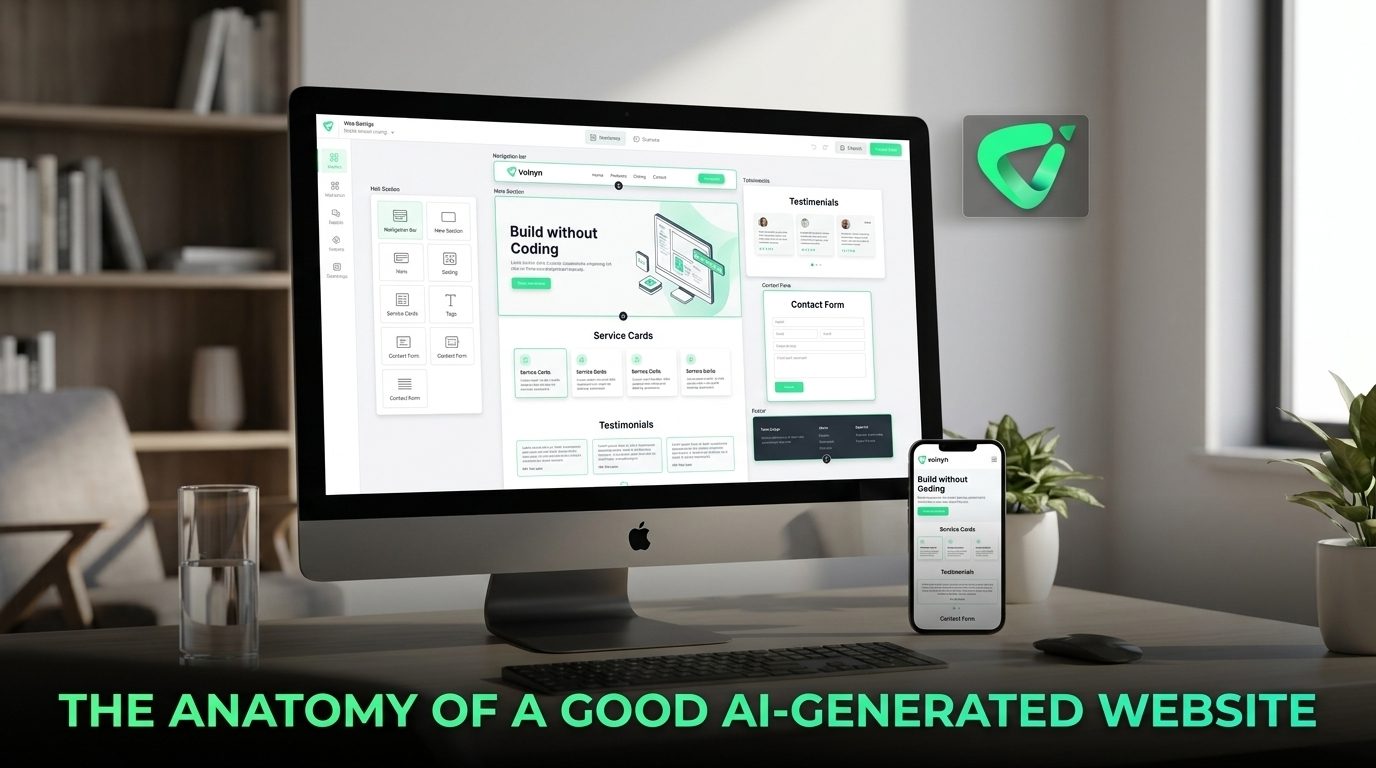
An AI website builder can remove much of the blank-page work, but the quality of the final website still depends on the decisions made during review and customization. Volnyn's AI Website Builder can generate website structure, content, and design from a description, while its visual editor lets users customize elements before publishing.
That makes the most useful workflow straightforward: let AI create the first complete version, then evaluate the result against the business goal, audience, content, design, accessibility, performance, SEO, and conversion criteria above.
Conclusion
The anatomy of a good AI-generated website is not a clever prompt or an attractive template. It is the combination of several parts working together: a clear purpose, logical structure, specific content, consistent design, credible proof, accessible and responsive experiences, solid technical foundations, and obvious conversion paths.
AI can accelerate the building process, but a published website still needs judgment. Treat the generated site as a working first version, inspect every important detail, replace anything generic or inaccurate, and test the experience before sending visitors there.

Be the first to leave a comment.