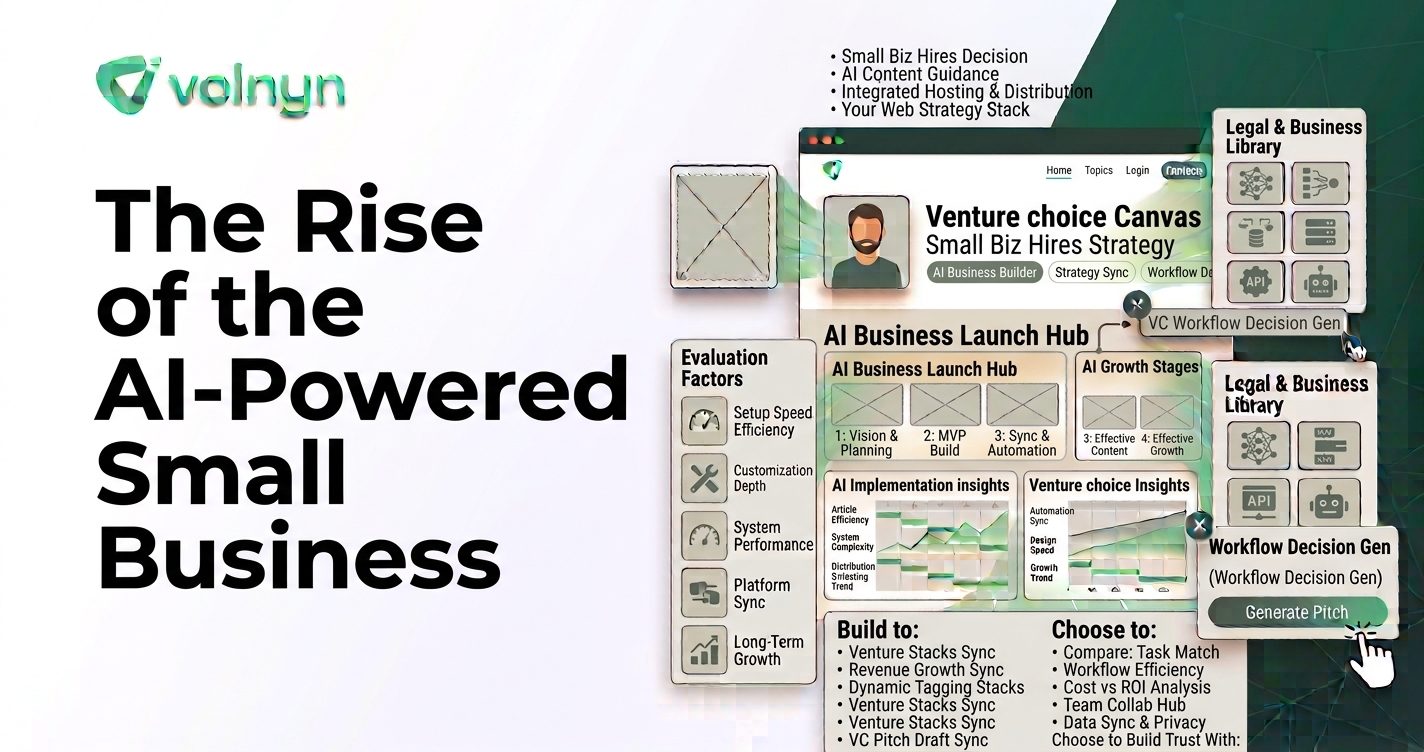
Small businesses are increasingly using artificial intelligence not as a futuristic experiment, but as part of ordinary work. Marketing, customer service, research, content creation, data processing, and digital production can now include AI-assisted workflows that would have been difficult or expensive for a very small team to manage before.
The shift is significant because small businesses often operate with limited time, people, and budgets. AI can give a founder or lean team another way to increase output without immediately adding another layer of software, outsourcing, or headcount.
But becoming an AI-powered business is not about adding an AI tool to every task. The real opportunity is to identify where AI removes repetitive work, improves execution, or helps a small team do something it could not easily do before.
Small Businesses Are Moving From AI Experimentation to Adoption
Recent research shows how quickly that transition is happening. A March 2026 Goldman Sachs survey of 1,256 small-business owners found that 76% were using AI, while 93% of those users said AI had a positive impact on their business. At the same time, only 14% said AI was fully integrated into their core operations, showing that adoption and effective implementation are not the same thing.
The U.S. Small Business Administration has also documented a narrowing gap between small and large businesses in AI adoption. Its 2025 research found that the share of small firms using AI had risen substantially, although larger businesses were still ahead.
Other datasets show similarly rapid growth. QuickBooks' 2026 AI Impact Report, based on more than 34,000 small and midsize business owners across the U.S., Canada, the UK, and Australia, reports that AI use among small and midsize businesses has risen sharply.
The exact adoption rate varies by survey, definition, country, and sample. The broader trend is clear: AI is moving into everyday small-business workflows.
What Does an AI-Powered Small Business Look Like?
An AI-powered small business does not necessarily have an AI department or a complicated automation system. It can be a two-person company using AI deliberately across several recurring tasks.
For example, a small business might use AI to:
- Research customers, competitors, and market opportunities.
- Draft and adapt marketing content.
- Summarize documents and organize information.
- Respond to common customer questions.
- Analyze business data and identify patterns.
- Generate website content and page structures.
- Create presentations and other business materials.
- Automate repetitive digital workflows.
The important point is not how many AI tools the business uses. It is whether those tools are connected to meaningful business outcomes.
Marketing Is One of the Biggest AI Opportunities
Marketing is particularly suitable for AI assistance because small businesses constantly need content and ideas but may not have a dedicated marketing department.
AI can help turn one piece of information into several useful formats. A business could start with a product description, customer question, case study, or article and develop social posts, email ideas, advertising concepts, FAQs, or website copy from it.
That does not eliminate the need for human review. Brand voice, factual accuracy, customer understanding, and final editorial decisions still matter. The advantage is that AI can reduce the amount of repetitive drafting required before a human makes those decisions.
AI Can Change How Small Businesses Build Digital Assets
Website creation is another area where the traditional workflow is changing. Instead of starting with an empty editor and manually planning every page, AI website builders can generate an initial structure from a description of the business.
Volnyn's AI website builder follows this approach. Users describe what they want to build, and the platform can generate website structure, content, and design as a starting point. Volnyn's current platform also supports visual customization, responsive websites, templates, and custom-domain functionality.
This changes the role of the business owner. Instead of needing to understand every technical step before starting, the owner can focus first on the business itself: who the website serves, what it offers, what information visitors need, and what action they should take.
The AI-Powered Business Is Not the Same as an Automated Business
It is easy to confuse AI adoption with automation. They are related, but they are not identical.
AI can assist a person with a task without performing the entire workflow independently. A business owner might use AI to draft a customer email, but still review and send it. A marketer might use AI to analyze campaign data, then decide what action to take.
Automation goes further by allowing a workflow to run with limited human intervention. That can be valuable for repetitive, predictable tasks, but it also introduces additional considerations around accuracy, permissions, privacy, and monitoring.
For many small businesses, the sensible starting point is AI assistance before full automation. Learn where AI reliably helps, then automate only workflows that are predictable enough to justify it.
The Biggest Opportunity May Be Doing More With the Same Team
One of the most interesting aspects of AI adoption is that small businesses do not necessarily need to view the technology as a replacement for people.
In a March 2026 Goldman Sachs survey, 87% of small-business owners using AI said it augmented rather than displaced employees. In another 2026 study, the U.S. Chamber of Commerce reported that AI-using small businesses were finding ways to work more efficiently and take on more challenging tasks.
This suggests a different model for growth: use AI to increase the capacity of existing people.
A founder can spend less time formatting documents and more time talking to customers. A marketing employee can spend less time producing first drafts and more time improving campaigns. A salesperson can spend less time organizing information and more time having conversations.
Why AI Adoption Still Fails for Some Small Businesses
Adding AI does not automatically improve a business. Poor implementation can create more work rather than less.
Common problems include:
- Using too many disconnected tools.
- Choosing software because it is popular rather than useful.
- Publishing AI-generated content without checking it.
- Giving sensitive business information to inappropriate tools.
- Automating a process that was not clearly defined in the first place.
- Failing to train employees on how and when AI should be used.
Goldman Sachs' 2026 research found that small businesses still face barriers including data privacy and security concerns, lack of technical expertise, and difficulty choosing the right tools. Those challenges explain why successful AI adoption requires more than simply subscribing to another application.
How to Build an AI-Powered Small Business Without Overcomplicating It
A practical approach is to start with the work that consumes the most time.
- Identify repetitive work. List tasks that happen every week and require significant manual effort.
- Choose one workflow. Start with a specific problem rather than trying to transform the entire business.
- Test the AI-assisted version. Measure whether it actually saves time or improves the result.
- Keep human review where it matters. Important customer, financial, legal, and strategic decisions should not be treated as automatic simply because AI is involved.
- Expand gradually. Once one workflow works reliably, look for another problem worth solving.
This approach also makes it easier to calculate whether an AI tool is delivering real value. The goal is not to maximize AI usage. The goal is to improve the business.
Volnyn's Role in the AI-Powered Small Business
Small businesses increasingly need to create more than a website. They may also need presentations, visual assets, digital products, research materials, and other business resources.
Volnyn describes itself as an AI workspace designed to turn ideas into digital assets using natural-language instructions. Its current platform includes tools for creating websites, presentations, images, games, spreadsheets, and other digital work. That broader approach fits the emerging small-business model: use AI where it removes friction, while keeping the business owner in control of the outcome.
The value of an all-in-one approach is not simply having more features. It is having fewer disconnected steps between an idea and the asset needed to execute it.
The Future Small Business May Be Smaller, Not Less Ambitious
AI could change the economics of starting and operating a small business by lowering the amount of manual work required to produce certain types of business output.
That does not mean every business will become a one-person company or that AI will eliminate the need for specialists. Complex decisions, relationships, creative direction, accountability, and industry expertise remain important.
Instead, the emerging model is one where a small team can use AI to extend its capabilities. A business with five people may be able to handle workflows that previously required more specialized support, while spending its human time on the areas where judgment and relationships matter most.
Conclusion
The rise of the AI-powered small business is not really about replacing traditional business practices with machines. It is about changing where human effort is spent.
The most useful AI adoption starts with practical problems: repetitive marketing work, customer communication, research, content production, data processing, website creation, and other tasks that consume time without necessarily requiring constant human creativity.
Start small, measure the result, protect sensitive information, review important outputs, and expand only when AI creates genuine value. For a small business, that may be more powerful than trying to become an “AI company.”
The businesses that benefit most may simply be the ones that learn how to use AI as another capable part of the team—without losing the human judgment that makes the business valuable in the first place.