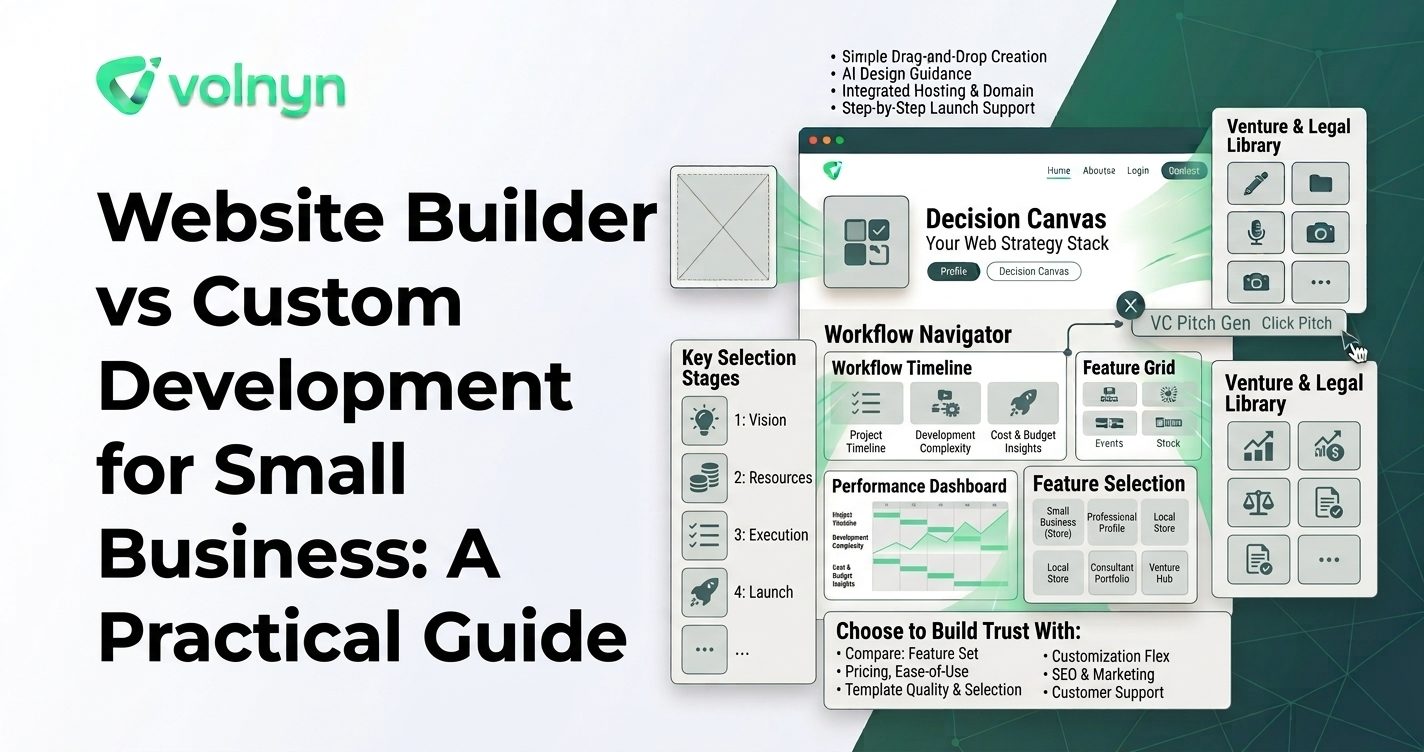
For a small business, choosing how to build a website is an important decision. A website builder can get a professional site online quickly, while custom development can provide much deeper control over functionality and implementation.
The right choice depends less on which approach sounds more advanced and more on what the business actually needs. A five-page service website has very different requirements from a custom customer portal, marketplace, or web application.
This guide compares website builders and custom development specifically from a small-business perspective, including cost, speed, customization, maintenance, SEO, and future growth.
What Is the Difference Between a Website Builder and Custom Development?
A website builder provides prebuilt infrastructure, templates, visual editing tools, hosting options, and other features that reduce the amount of technical work required to create a website.
With a modern AI website builder, the initial setup can be even faster. For example, Volnyn's AI website builder can generate a website's structure, content, and design from a description, after which the user can customize the result with a visual editor.
Custom development takes a different approach. Developers build the website or application around the project's specific requirements. The team can control the architecture, functionality, integrations, database behavior, and underlying code.
That additional control can be valuable, but it generally requires more technical expertise and more involvement during development and maintenance.
Website Builder vs Custom Development: Quick Comparison
| Factor |
Website Builder |
Custom Development |
| Initial setup |
Usually faster |
Usually requires more planning and development |
| Technical skill |
Low to moderate |
Usually high |
| Upfront complexity |
Lower |
Higher |
| Design flexibility |
Depends on the platform |
Very high |
| Custom functionality |
Limited by platform capabilities |
Can be developed specifically for the project |
| Maintenance |
Often simpler on hosted platforms |
Usually requires technical resources |
| Best suited to |
Standard business websites and common workflows |
Specialized websites and applications |
When a Website Builder Makes More Sense
For many small businesses, the website's primary job is straightforward: explain what the company does, build trust, generate enquiries, showcase products or services, and give customers a way to get in touch.
Those requirements usually do not require a completely custom technical architecture.
A website builder can be a practical fit when you need:
- A company or service website
- A portfolio
- A landing page
- A restaurant or local business website
- A blog
- A standard online store
- Contact forms and lead-generation pages
Volnyn's current website builder supports business websites, ecommerce, portfolios, landing pages, and blogs. It also provides templates, visual editing, hosting, responsive websites, and custom-domain support. ([volnyn.com](https://volnyn.com/ai-website-builder))
The main advantage is reducing the amount of work between having an idea and having a usable website. Instead of planning every component from scratch, you can begin with a generated or template-based structure and customize it around the business.
When Custom Development Makes More Sense
Custom development becomes more relevant when the website is actually part of a larger software system.
Examples can include:
- A customer portal with specialized account functionality
- A marketplace with custom workflows
- A highly specialized booking or scheduling system
- Complex integrations with internal business systems
- Custom databases and application logic
- Business software that happens to run through a browser
In these situations, the question is no longer simply how to publish pages. The business may need functionality that a particular website platform does not support or cannot support without significant workarounds.
Custom development can provide more control over the implementation, but that control comes with additional responsibility for architecture, testing, security, deployment, updates, and ongoing technical support.
Cost: Look Beyond the Starting Price
Comparing a website builder and custom development purely by their initial price can produce a misleading result.
A website builder may involve a subscription or other platform costs, but it can bundle services that would otherwise need to be managed separately. Depending on the platform, these may include hosting, templates, editing tools, responsive behavior, and other website infrastructure.
Custom development can involve costs for design, development, testing, hosting, maintenance, security updates, and future changes.
The more useful question is therefore:
What will it cost to build, operate, maintain, and change the website over the next few years?
A business should estimate the total workload rather than comparing only the cost of launching version one.
Speed vs Customization
The central trade-off is often speed versus control.
A website builder gives you a defined environment. That can limit some types of customization, but it also means you do not have to design the entire technical system yourself.
Custom development gives you greater freedom to define how the system works. The downside is that more decisions have to be made before the final product is ready.
For a small business that needs a marketing website quickly, spending months developing functionality that customers do not need may add unnecessary complexity.
For a company whose website is itself a core software product, accepting platform limitations simply to launch faster may create problems later.
What About SEO?
Neither approach automatically guarantees strong search performance.
SEO depends on factors including useful content, site structure, crawlability, technical implementation, mobile usability, page experience, and how well the site satisfies the searcher's needs.
Google's current guidance emphasizes overall page experience, including mobile usability, secure delivery, and Core Web Vitals, while also noting that good page-experience metrics do not guarantee top rankings. ([developers.google.com](https://developers.google.com/search/docs/appearance/page-experience))
Website builders can provide SEO-related controls and infrastructure, but businesses still need to create useful pages, write descriptive titles and content, optimize images, build sensible navigation, and monitor the site's performance.
Custom development provides more control over the technical implementation, but that does not automatically produce better SEO. A poorly structured custom website can perform worse than a well-maintained site built on a managed platform.
Maintenance Is Part of the Decision
A website is not finished when it goes live.
Businesses may need to update services, change prices, publish articles, add products, modify landing pages, improve forms, update integrations, and keep the site secure.
With a managed website platform, some infrastructure responsibilities are handled by the provider. Volnyn, for example, describes its website builder as including hosting and responsive website functionality, while allowing users to make visual changes without coding. ([volnyn.com](https://volnyn.com/ai-website-builder))
With custom development, maintenance responsibilities depend on how the project is built and who manages it. A business may need an internal developer, an agency, or an external development partner for ongoing changes.
That ongoing workload should be included when evaluating the two approaches.
Think About the Website You Need in Two Years
One useful way to make the decision is to avoid building for hypothetical problems while also avoiding a short-term solution that obviously cannot support the business's plans.
Ask:
- Will the site remain primarily informational?
- Will we add ecommerce?
- Will customers need accounts?
- Will we need a booking system?
- Will the site need to connect to internal software?
- Will we need unusual workflows or application logic?
- Who will maintain the site?
- How important is portability or migration?
If the answers point toward standard website functionality, a builder may provide enough flexibility. If they point toward a specialized application, custom development deserves closer consideration.
A Simple Decision Framework for Small Businesses
Use the following framework before committing to either approach.
- Define the business goal. Decide what the website needs to accomplish for customers and for the business.
- List required functionality. Separate essential features from ideas that can wait until later.
- Check platform limitations. Confirm that your chosen builder supports the integrations, ecommerce features, forms, or workflows you actually need.
- Estimate ongoing work. Consider who will update content, manage technical issues, and handle future changes.
- Compare total cost. Include development, subscriptions, hosting, maintenance, and future changes.
- Choose the simplest approach that meets the requirements. Do not pay for technical complexity that the business does not need.
Could a Small Business Start With a Builder?
For a business whose immediate goal is to establish an online presence, starting with a website builder can be a sensible way to validate the website's structure and customer needs before investing in a more complex system.
That does not mean a builder has to be the permanent answer. Requirements can change. A business can later evaluate whether its growing needs justify custom development.
The important thing is to understand the platform's capabilities and limitations before building a critical workflow around it.
If you want to test this approach, Volnyn's AI website builder lets you describe a business and generate a starting website, then customize the structure, text, images, colors, and sections with its visual editor.
Conclusion
The website builder vs custom development decision is ultimately about matching technical complexity to business requirements.
A website builder can reduce setup time and technical workload for standard business websites, portfolios, landing pages, blogs, and common ecommerce needs. Custom development becomes more relevant when the website requires specialized functionality, complex integrations, or application-level control.
There is no reason to choose the more complicated approach simply because it sounds more professional. Likewise, there is little value in forcing a complex software requirement into a platform that cannot support it properly.
Start with the business problem, identify the functionality that actually matters, calculate the ongoing workload, and then choose the approach that gives you enough flexibility without unnecessary complexity.
For businesses that want to explore the builder route, Volnyn also provides an all-in-one workspace for bringing website creation and other digital work together.