AI can now produce a working website from a short description, but that does not mean AI is automatically the right choice for every website project. The better question is whether your website is simple enough, urgent enough, and flexible enough for an AI builder to give you a strong starting point.For a small business, freelancer, creator, startup, campaign, portfolio, or early-stage idea, the answer is often yes. For a highly specialized website with unusual functionality, strict technical requirements, or extensive custom integrations, a different approach may make more sense.
Here is how to decide.
Use AI When You Need a Website Quickly
Speed is one of the clearest reasons to use an AI website builder. If you need a professional web presence this week rather than spending weeks planning every page, AI can remove much of the initial setup work.
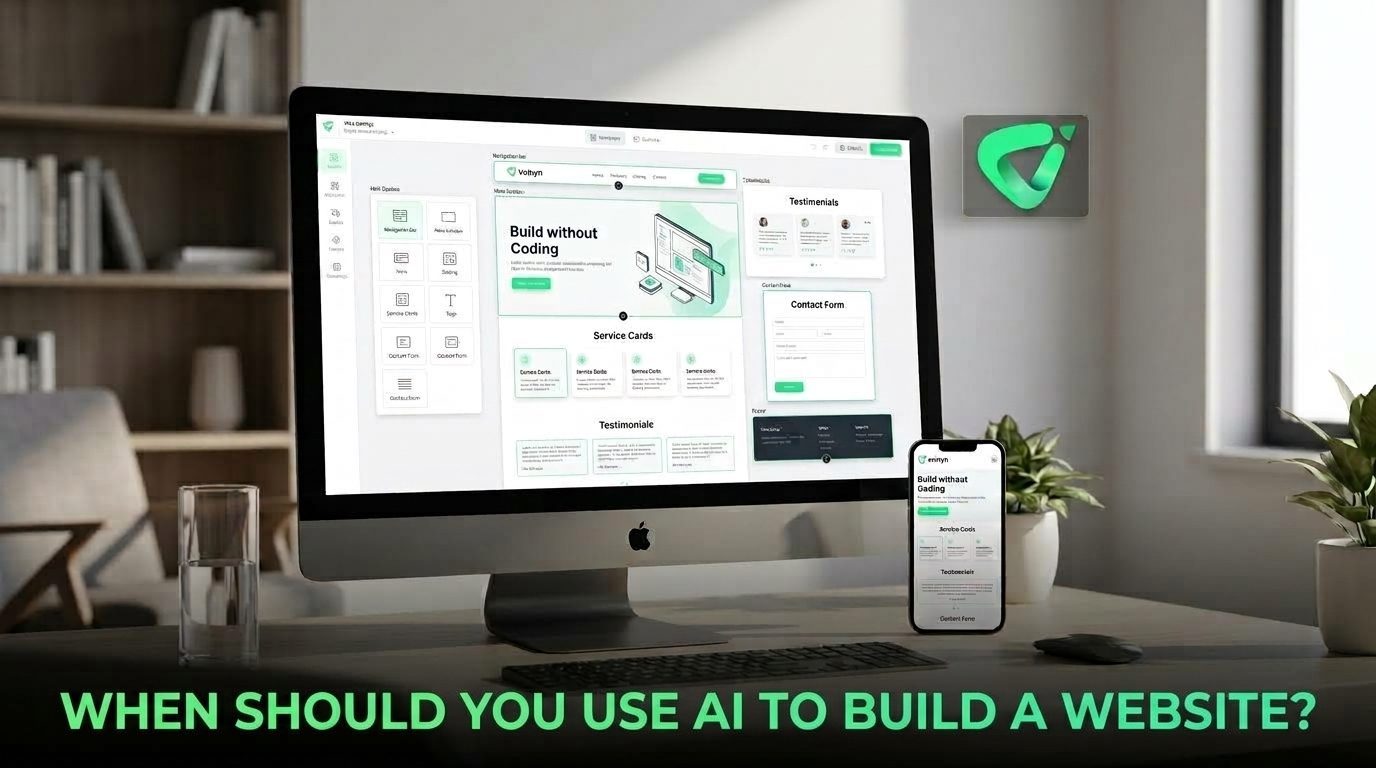
Modern AI builders can turn a description of your business into a starting structure, including page layouts, content, imagery, and navigation. Volnyn, for example, lets you describe what you want to build and generates a website structure that you can then customize before publishing.
This is particularly useful when the alternative is delaying the website because you are still choosing a designer, learning a development platform, or starting from a blank page.
AI Is a Good Fit for Common Website Types
AI website builders are most useful when the website has a familiar structure and a clear purpose. You generally do not need highly specialized development just to create a useful online presence.
- Small business websites: Explain your services, location, contact details, and business proposition.
- Freelancer portfolios: Present your work, background, services, and contact information.
- Landing pages: Promote a product, campaign, event, or specific offer.
- Service websites: Help potential customers understand what you offer and how to get in touch.
- Early-stage ideas: Create a credible web presence before investing heavily in a full custom build.
- Simple online stores: Start with standard product, cart, and checkout requirements where the platform supports them.
Volnyn currently supports business websites, online stores, portfolios, landing pages, and blogs, with templates and visual customization available after the initial AI-generated draft. Explore Volnyn's AI website builder if you want to see how that workflow works.
Use AI When You Know What the Website Needs to Do
An AI builder works best when you can describe the website's purpose clearly. You do not need to know HTML or CSS, but you should know who the site is for and what you want visitors to do.
For example, “build a website for my business” is a weak starting point. “Build a website for a family-run catering company that serves corporate events, showcases three catering packages, collects booking inquiries, and operates in Lahore” gives the builder much more useful context.
Before generating the site, define four things:
- The audience you want to reach.
- The main action you want visitors to take.
- The essential pages or information they need.
- The facts, branding, images, and business details that must be accurate.
The AI can help turn that information into a structure, but you remain responsible for deciding whether the result represents your business correctly.
When AI Website Building May Not Be the Best Choice
AI is not a replacement for every kind of web development. A custom development approach may be more appropriate when the website depends on unusual functionality, complicated integrations, highly specialized workflows, or requirements that a standard builder cannot accommodate.
This can include projects where the website is effectively a custom software product rather than a conventional marketing site. If the core value of the project comes from bespoke application logic, specialized infrastructure, or deep integration with internal systems, evaluate the technical requirements before choosing an AI builder.
The same principle applies when your business has strict accessibility, security, compliance, or performance requirements. Standards such as the Web Content Accessibility Guidelines provide a framework for making web content accessible, while Google's guidance emphasizes overall page experience and good Core Web Vitals. These requirements should be evaluated rather than assumed to be solved automatically by any website builder.
AI Should Build the First Version, Not Make Every Decision
One of the most useful ways to think about AI website building is as an accelerated first draft.
The builder can handle repetitive production work, but you should review the parts that affect your reputation and customers. Check every business claim, service description, price, contact detail, image, call to action, and piece of generated copy before publishing.
Pay particular attention to whether the site sounds like your business. A technically complete website can still feel generic if it uses vague claims and interchangeable language.
You should also test the finished site yourself. Open it on a phone, follow the navigation, submit forms, check important links, and make sure visitors can quickly understand what you offer. Google's page-experience guidance recommends looking beyond individual metrics and considering the overall experience across devices and interactions.
A Simple Decision Framework
| Website situation |
AI builder fit |
Why |
| Need a business website quickly |
Strong |
AI can generate a useful starting structure without a long development process. |
| Building a freelancer portfolio |
Strong |
The structure is relatively straightforward and easy to customize. |
| Testing a new business idea |
Strong |
You can establish a web presence before making a larger development investment. |
| Launching a simple campaign |
Strong |
A focused landing page is well suited to template and AI-assisted creation. |
| Building highly specialized software |
Depends |
Custom development may be necessary for unusual functionality or integrations. |
| Complex technical or compliance requirements |
Evaluate carefully |
Requirements should be tested rather than assumed to be covered automatically. |
How to Get Better Results From an AI Website Builder
If you decide AI is appropriate, give it enough information to make useful decisions. Start with your real business details rather than relying on generic descriptions. Provide your audience, services, location where relevant, website goal, preferred style, and important content.
Then treat the generated site as a draft. Replace generic copy with your actual expertise, use authentic images where possible, check the mobile experience, and remove anything that does not accurately represent your business.
This approach also aligns with Google's broader recommendation to create useful, people-first content rather than relying on automation simply to produce more pages. Google's guidance on helpful, reliable content emphasizes originality, usefulness, and satisfying the reader's goal.
So, When Should You Use AI to Build a Website?
Use AI when the main challenge is getting from an idea to a solid website quickly and your requirements fit a standard website structure. It is especially valuable when you do not have coding or design experience and do not want those skills to become a barrier to launching.
Do not choose AI simply because it is fashionable. Choose it when it solves a real constraint: time, complexity, budget, or the difficulty of starting from scratch.
For many small businesses, freelancers, creators, and early-stage projects, that makes an AI builder a practical starting point. Volnyn's AI website builder can turn a plain-language description into a website draft, after which you can edit the content, images, colors, sections, and other details before going live.
The goal is not to let AI decide what your website should be. The goal is to use AI to get a strong version on the screen faster, then apply your own judgment to make it accurate, useful, accessible, and genuinely yours.
Be the first to leave a comment.