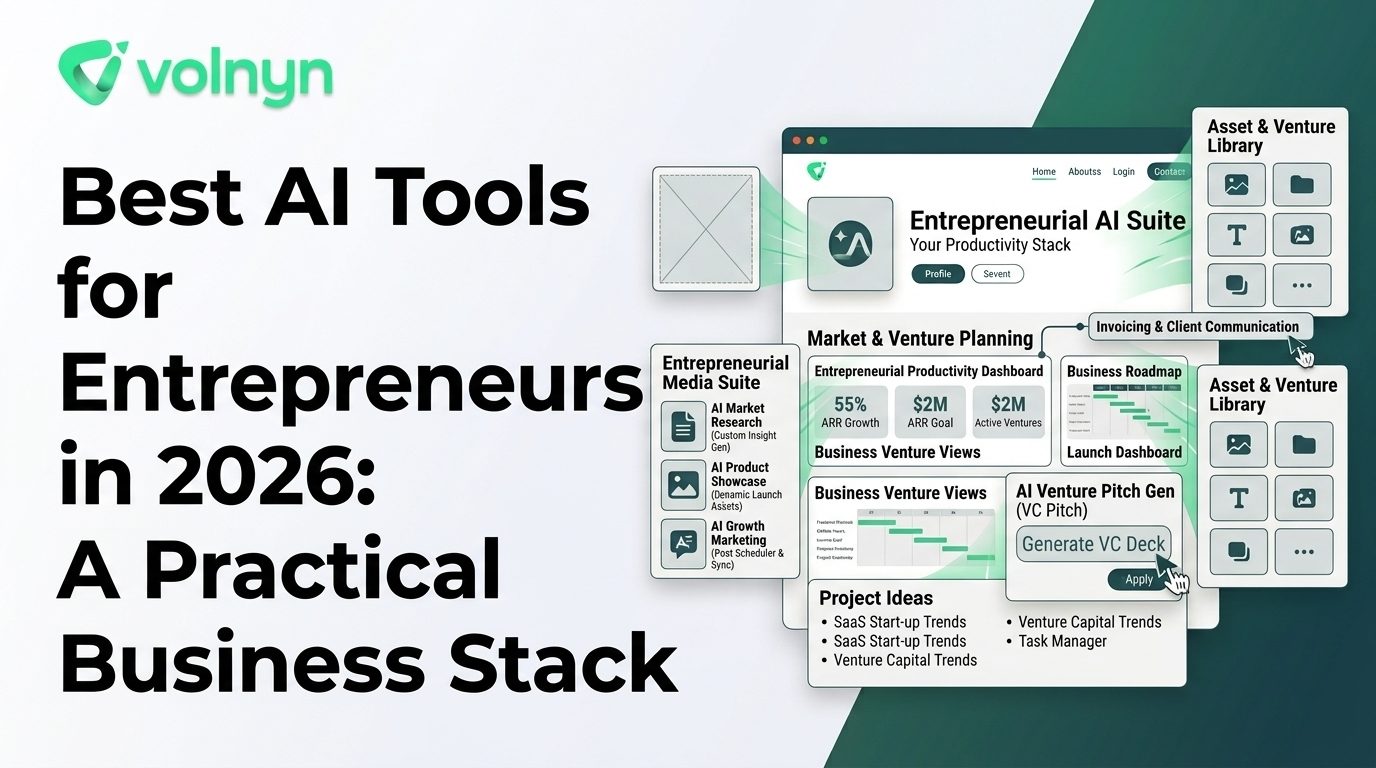
Entrepreneurs rarely struggle because there is only one thing to do. The harder problem is having to handle ten important things at once: researching customers, planning products, creating marketing content, building a website, preparing presentations, answering questions, managing operations, and deciding what deserves attention next.
That is where AI tools can become useful. The right tools can help a small team move faster without requiring a separate specialist for every task. But the goal should not be to collect as many AI subscriptions as possible. A practical AI stack should solve specific business problems, fit the way you already work, and leave important decisions under human control.
This guide looks at useful AI tools for entrepreneurs in 2026, organized around the jobs they can help with rather than simply listing software features.
What Should Entrepreneurs Look for in an AI Tool?
An AI tool can sound impressive and still have little value for a real business. Before adding one to your workflow, consider whether it does one of these things well:
- Reduces repetitive work: It should save time on tasks you perform regularly.
- Improves output: It should help you produce better research, content, designs, or business materials.
- Works with your existing stack: Useful integrations can prevent AI from creating another isolated workflow.
- Allows human review: You should be able to check, edit, and approve important outputs.
- Provides clear business value: The tool should save meaningful time, improve customer experience, or help you execute an important business task.
The U.S. Small Business Administration similarly recommends that small businesses start small when adopting AI, test whether a tool actually adds value, and consider both its benefits and risks. Its guidance on AI for small businesses also highlights use cases including content creation, repetitive tasks, customer service, brainstorming, and data analysis.
Best AI Tools for Entrepreneurs in 2026
| Tool |
Best For |
Entrepreneurial Use Case |
| ChatGPT |
General business assistance |
Research, brainstorming, writing, analysis, planning, and customer communication |
| Notion AI |
Knowledge and project management |
Organizing plans, meeting notes, documents, tasks, and business knowledge |
| Canva |
Marketing and visual content |
Social graphics, presentations, campaigns, and branded business materials |
| Zapier |
Automation |
Connecting business applications and automating repetitive workflows |
| Volnyn |
Websites and business assets |
Building websites, applications, presentations, and other digital business assets |
ChatGPT: Best for General Business Assistance
ChatGPT can act as a general-purpose AI assistant across many stages of running a business. Entrepreneurs can use it to brainstorm product ideas, summarize research, draft emails, analyze information, structure business plans, create content outlines, and explore potential customer questions.
OpenAI has also introduced a small-business program focused on helping entrepreneurs use AI for productivity and business growth. Its current business offering describes AI assistance for tasks including research, content creation, and work across apps and files. OpenAI's small-business guidance provides more detail.
The important distinction is that AI can accelerate thinking and execution, but it should not automatically become the final decision-maker. Entrepreneurs still need to validate assumptions, check important information, and apply knowledge of their customers and market.
Notion AI: Best for Organizing the Business
Notion AI is useful for entrepreneurs who need a central place for plans, documentation, tasks, notes, and business knowledge. Because AI is integrated into the Notion workspace, it can help users work with information already stored there rather than constantly switching between separate tools.
Current Notion capabilities include AI-powered search across connected information, meeting notes, agents, and support for working with files such as presentations and spreadsheets. Notion's AI documentation outlines its current capabilities and plan requirements.
This makes it particularly useful for keeping product research, operating procedures, campaign plans, meeting notes, and other business knowledge organized as a company grows.
Canva: Best for Marketing and Visual Content
Canva is useful when an entrepreneur needs to turn ideas into customer-facing visual material. Its AI capabilities support design, writing, presentations, marketing content, and other creative workflows.
For a small business, that could mean turning a campaign brief into social content, adapting one design for several channels, creating a presentation for a sales meeting, or developing marketing assets without starting each design from a blank canvas.
Canva's current AI direction also emphasizes conversational creation and editable designs, giving entrepreneurs the ability to generate a starting point and then refine the result manually.
Zapier: Best for Automating Repetitive Operations
Zapier is valuable when an entrepreneur is spending too much time moving information between applications. Its automation platform connects thousands of apps and can add AI steps to workflows.
For example, a new lead could trigger a workflow that records the inquiry, categorizes it, creates a task, and alerts the appropriate person. Other workflows can handle repetitive steps around onboarding, marketing, notifications, or internal administration.
Zapier's current documentation describes AI-assisted workflow building as well as AI steps that can summarize, classify, draft, or make decisions within automated processes. Zapier's documentation provides details on its current automation platform.
Volnyn: Best for Building a Digital Business Presence
Entrepreneurs often need several digital assets at once: a website, landing page, online store, presentation, or even a more advanced web application. Using separate tools for every project can create unnecessary handoffs and maintenance.
Volnyn's all-in-one workspace brings website creation, documents, and presentations together. Its current workflow lets users describe what they need, generate a starting point with AI, and continue editing and publishing from the same workspace.
Its AI Website Builder can generate a website from a business description and supports business websites, landing pages, portfolios, blogs, and online stores. Volnyn currently lists 550+ templates and visual editing options, allowing entrepreneurs to customize the generated result rather than starting with an empty canvas.
For entrepreneurs who need to establish a professional online presence quickly, this can make the website part of the launch process less dependent on coding or separate design workflows.
Choose AI Tools by Business Stage
The best AI stack can change as the business develops. A new entrepreneur may need tools for validating an idea and creating a basic online presence, while a growing company may benefit more from automation and structured knowledge management.
| Business Stage |
Useful AI Focus |
Example Tasks |
| Idea stage |
Research and validation |
Customer research, brainstorming, competitor analysis, business planning |
| Launch |
Digital presence and marketing |
Website, landing page, branding, presentations, launch content |
| Early growth |
Content and operations |
Marketing campaigns, documentation, customer communication, task management |
| Scaling |
Automation and systems |
Lead routing, onboarding, reporting, internal workflows, knowledge management |
How to Build a Practical AI Stack
Entrepreneurs do not need to adopt every new AI product. A smaller stack is often easier to manage and easier for a team to learn.
- Identify your biggest bottleneck. Find the recurring task that consumes the most time or slows down an important business process.
- Choose one tool to address it. Test the simplest suitable option before adding more software.
- Create a repeatable workflow. Turn successful experiments into a process that can be reused.
- Keep human approval where it matters. Review customer-facing copy, financial information, strategic decisions, and other high-impact outputs.
- Measure the result. Compare the time, quality, and cost before and after introducing the tool.
- Remove unnecessary tools. If an AI product does not create measurable value, it may not deserve a permanent place in the stack.
Common Mistakes Entrepreneurs Make With AI
The biggest mistake is treating AI adoption as a software-collection exercise. More tools do not automatically create a more efficient business.
Another common problem is publishing AI-generated material without review. AI can produce convincing but incorrect information, generic messaging, or content that does not reflect a company's actual customers. The entrepreneur remains responsible for checking the result.
Privacy also matters. Before putting customer information, confidential documents, financial data, or proprietary business material into an AI service, review the provider's data practices and choose an appropriate business plan or workflow where necessary.
Conclusion
The best AI tools for entrepreneurs are not necessarily the ones with the longest feature lists. They are the tools that remove meaningful friction from the work of building and running a business.
ChatGPT can support research, planning, writing, and analysis. Notion AI can help organize business knowledge. Canva can accelerate visual marketing. Zapier can automate repetitive workflows. Volnyn can bring website creation, applications, presentations, and other digital business-building tasks into a single AI-powered environment.
If you are starting or growing a business, begin with one clear problem rather than trying to automate everything at once. Choose a tool, test it against a real workflow, review its output carefully, and keep it only if it creates measurable value. That approach turns AI from another source of complexity into a practical part of the business.