
Welcome to Volnyn
Sign in or create an account to continue
Continue with Google
or
Sign in with email
New here? Create an account
By continuing, you agree to our Terms of Service
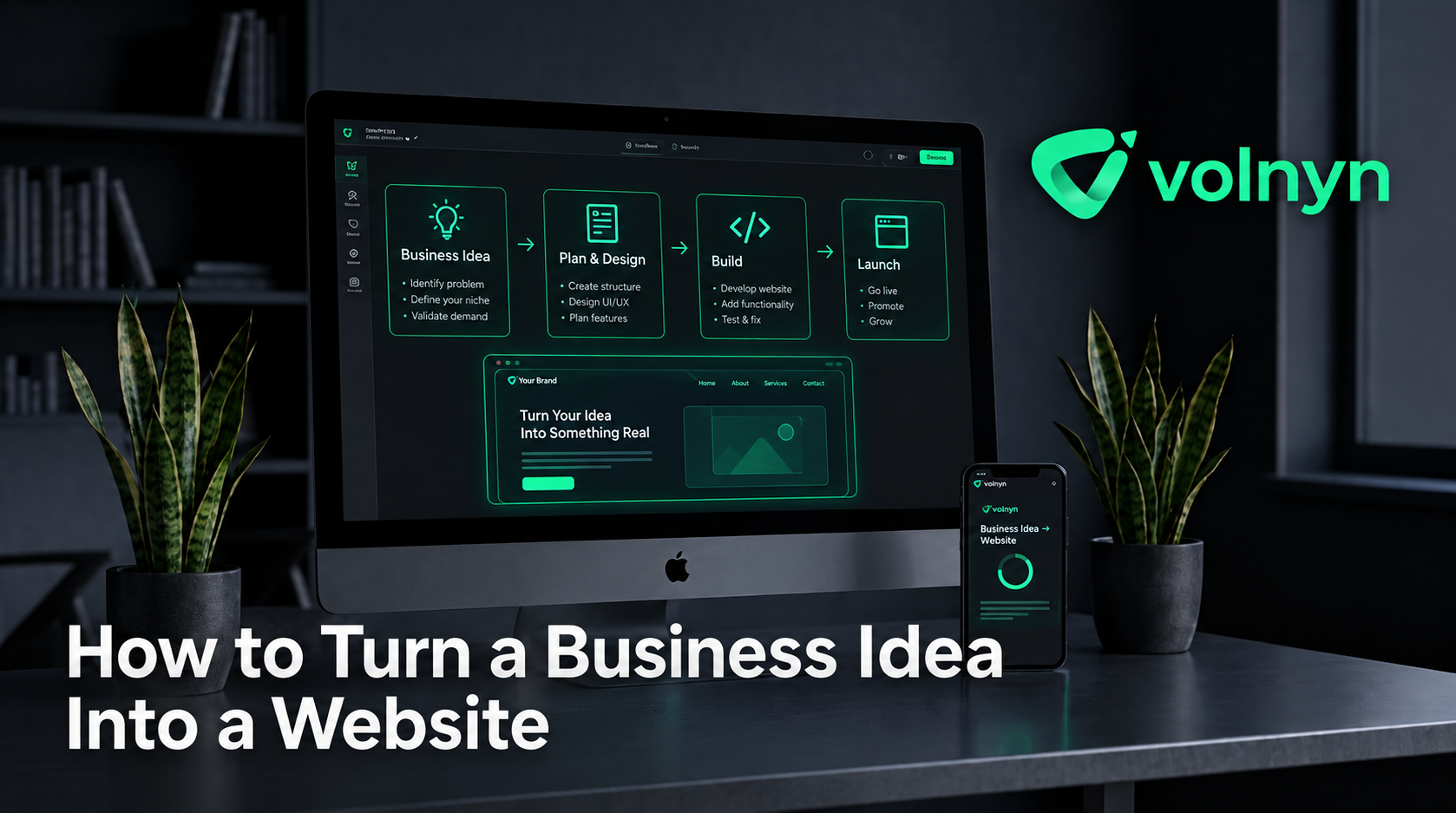
The most effective approach is to treat the website as the first practical version of the business itself. Start with the offer and customer, then build the pages and content around them.
Before choosing colors, layouts, or a domain name, write down the simplest possible explanation of the business.
A useful formula is:
We help [specific customer] achieve [specific outcome] through [product or service].
For example, instead of saying “I want to start a fitness business,” you might define the idea as “We provide online strength-training programs for busy professionals who want structured workouts without going to a gym.”
That difference matters because the second version immediately suggests what the website needs to communicate: the target customer, the problem, the service, and the expected result.
Not every business website has the same job. A local service business may want phone calls or booking requests. A consultant may want people to schedule a conversation. An online store needs customers to browse products and complete purchases. A new business concept may simply need to collect interest and validate demand.
Choose one primary outcome for the website before building it.
Secondary goals can exist, but one primary action should guide the structure of the site.
You do not need dozens of pages to make a new business look credible. Start with the information a potential customer actually needs before deciding whether to contact or buy from you.
| Page or Section | Purpose |
|---|---|
| Homepage | Explain the offer and guide visitors toward the main action |
| Services or Products | Show what customers can buy or request |
| About | Explain who is behind the business and why it exists |
| Proof | Build confidence through testimonials, examples, credentials, or results |
| Contact or Booking | Give visitors a clear way to take the next step |
Some businesses will need additional pages, such as pricing, an FAQ, a portfolio, a blog, or an online store. The principle is simple: add pages because customers need the information, not because a website feels incomplete without them.
The homepage should answer a visitor's basic questions quickly.
Within the opening section, make it clear what the business does, who it serves, and what the visitor can do next. Avoid leading with vague statements such as “Welcome to our company” or “We are passionate about excellence.” Those phrases consume valuable space without explaining the offer.
A stronger structure is:
This structure turns the homepage from a digital brochure into a path toward action.
A new business often has one major disadvantage: it does not have an established reputation yet. Your website therefore needs to reduce uncertainty wherever possible.
Use genuine evidence that supports the business. Depending on the type of company, that might include previous work, founder experience, qualifications, product demonstrations, customer testimonials, case studies, guarantees, transparent pricing, or clear contact information.
If you do not have testimonials yet, do not invent them. Use other forms of evidence instead. A new business can still demonstrate expertise through useful information, examples, samples, demonstrations, or a clear explanation of how the service works.
Your domain should be easy to remember, easy to communicate, and appropriate for the direction of the business. Before committing to one, check that it does not create obvious confusion with another brand and that it still makes sense if the company expands.
You also need a small set of consistent visual choices: a logo, colors, typography, imagery, and a recognizable tone of voice. You do not need a full corporate identity before launching. You need enough consistency that the website feels like one business rather than a collection of unrelated sections.
One of the biggest mistakes new business owners make is treating the first website as if it needs to be permanent.
It does not.
The first version should be useful, credible, and clear enough to put in front of real people. Once you have feedback, you can improve the copy, add questions customers repeatedly ask, refine the offer, strengthen the calls to action, and create additional pages.
This is where an AI website builder can reduce the distance between an idea and a usable first version. Volnyn's AI website builder can generate a starting website from information about the business, while its templates provide industry-specific starting points. You can then replace generic material with your actual services, pricing, images, and business information.
Before publishing, run through a short quality check. Small errors can undermine an otherwise strong first impression.
Google's current SEO guidance emphasizes useful, well-organized, original content and recommends making pages easy for both users and search engines to understand. Google's SEO Starter Guide is a useful reference when reviewing the search basics of a new site.
A website can do more than announce that a business exists. It can help you learn whether the idea resonates with potential customers.
Pay attention to what people actually do. Do they click the main call-to-action? Do they ask the same questions repeatedly? Which service receives the most interest? Are visitors reaching the contact or booking page?
You can use those signals to refine the business itself. If visitors consistently misunderstand the offer, the problem may be the positioning rather than the design. If people like the concept but hesitate at the next step, the pricing, proof, or offer structure may need work.
The website therefore becomes part of the feedback loop: idea, website, real visitors, feedback, improvement.
An AI website builder is particularly useful when the main obstacle is getting from a blank page to a workable first version. It can help with structure, initial content, and design direction so you can spend more time deciding what the business should actually say.
Volnyn also lets users keep related work in one workspace. Its all-in-one workspace brings websites, site documents, and presentations together, which can be useful when a new business needs more than a public-facing website.
The important distinction is that AI should provide a starting point, not replace business judgment. Your real offer, customer knowledge, proof, pricing, and positioning are what make the finished website useful.
Turning a business idea into a website is easier when you stop thinking about the website as the final product. The first site is a practical version of the business: it explains the offer, identifies the customer, establishes trust, creates a path to action, and gives you a way to learn from real visitors.
Start with the problem you solve. Define the audience. Choose one primary goal. Build only the pages customers need. Add genuine proof, test everything on mobile, and publish when the site is clear enough to be useful.
If getting the first version built is what is holding the idea back, Volnyn's AI website builder can provide the starting structure without requiring coding skills. The important part is what comes after that first draft: making the website specific to your business and improving it based on what real customers need.