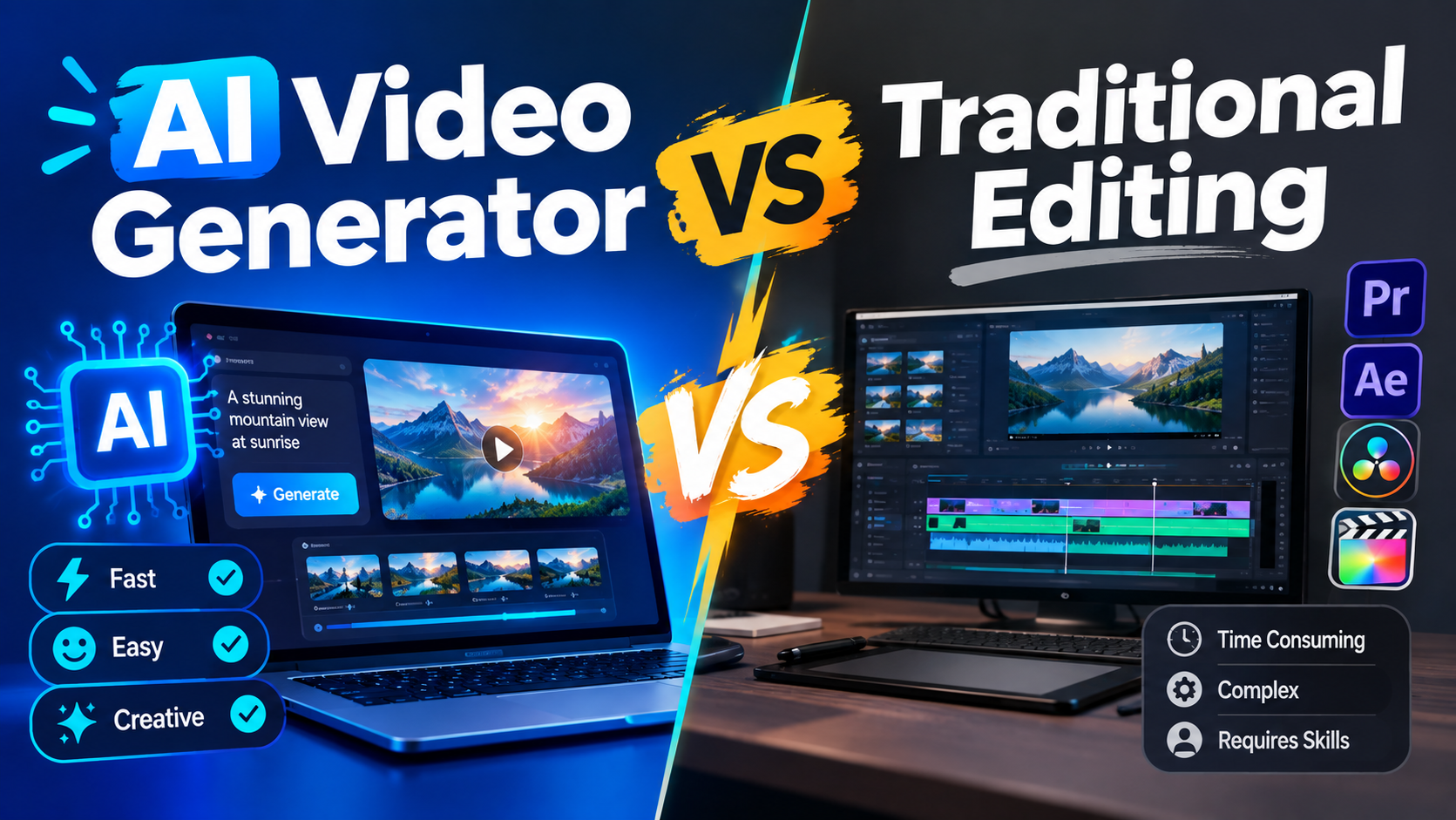
If you've ever typed a sentence into an AI tool and watched it spit out a video clip, you've probably had the same thought a professional editor has when they see it: this is either going to replace half my job, or it's a toy. Neither answer is quite right, and the confusion is understandable — these are two genuinely different ways of making video, not two versions of the same thing.
This guide breaks down what actually separates an AI video generator from a traditional editing workflow, where each one wins, and how to decide which fits the project in front of you.
What "traditional video editing" actually means
Traditional editing starts with footage — filmed, screen-recorded, or licensed — and a human editor assembling it inside software like Adobe Premiere Pro, Final Cut Pro, or DaVinci Resolve. The editor chooses which take to use, where to cut, how long to hold a shot, how the color should feel, and how the audio should sit under the picture. Every decision is manual, even when the software automates small mechanical steps like syncing audio or applying a saved preset.
This is worth understanding historically, because "traditional" itself has already changed once before. Early film editors like Sergei Eisenstein worked by physically cutting film strips with scissors and reassembling them by hand — a linear process where you had to edit in sequence, from the beginning of the film to the end, because there was no other way to access the footage. Editors like Sergei Eisenstein cut film strips by hand, and this linear method — editing in the same order as the final sequence — remained the norm well into the era of videotape. The Moviola, invented in 1924, was the first machine built specifically for this kind of film editing, and versions of it are still occasionally used in Hollywood today.
The real shift toward what we now call "traditional" editing happened with non-linear editing (NLE) — software that lets you jump to any point in a project and change it without re-cutting everything after it. That idea dates back to 1971, when CBS and Memorex built the CMX 600, an editing system that cost close to a million dollars and stored roughly 30 minutes of footage on disk drives the size of washing machines. It took another two decades for that technology to become affordable and usable enough for everyday editors — Avid Media Composer and, later, Adobe Premiere, brought non-linear editing to desktop computers in the late 1980s and 1990s, and that's the workflow most editors still use today.
So "traditional editing," as most people mean it now, is really the second generation of a much older craft: manual creative decisions, made by a person, inside digital software instead of on physical film.
What an AI video generator does differently
An AI video generator skips the filming step entirely. You describe a scene, a subject, a style, or a mood in a text prompt (sometimes with a reference image), and the model generates a video clip that matches the description — no camera, no actors, no editing timeline required at first pass. Tools in this category include Sora, Runway, Google's Veo, Kling, Luma, and Volnyn's own AI video generator, which turns a text prompt into a downloadable clip you can use for social content, ads, product visuals, or B-roll.
The underlying difference isn't just "faster editing." It's a different starting point. Traditional editing assembles something that was captured. AI generation synthesizes something that never existed as footage — the model has learned patterns from enormous amounts of video and image data and predicts what a matching scene should look like, frame by frame.
That distinction explains almost every practical difference below.
Side-by-side comparison
Factor | Traditional Video Editing | AI Video Generator |
Starting point | Filmed or sourced footage | A text prompt or reference image |
Skill required | Editing software, storytelling, often filming/lighting knowledge | Writing a clear, descriptive prompt |
Speed | Hours to weeks, depending on scope | Seconds to a few minutes per clip |
Cost | Equipment, crew, location, software, editor time | Software subscription only, often with a free tier |
Creative control | Frame-by-frame precision over pacing, framing, color, performance | Directional control through prompts; less precise at the frame level |
Consistency across scenes | High — same actor, set, and lighting throughout | Improving, but keeping a character or product identical across multiple clips is still harder |
Best for | Narrative films, documentaries, brand films, anything needing real performances | Social clips, ad concepts, explainer visuals, B-roll, quick iteration |
Ownership and rights | Fully yours — you filmed or licensed it | Depends on the platform's terms; check before commercial use |
Editing after the fact | Fully editable at any stage | Often means regenerating rather than fine-tuning a specific frame |
Learning curve | Steep — software and craft both take time | Low — most tools are usable within minutes |
What AI video generation is genuinely good at
Speed from idea to draft. A concept that would take a shoot day and an editing pass can become a usable draft in minutes, which matters most when you need to test several directions before committing budget to one.
Lowering the barrier to entry. Someone with no camera, no editing software, and no crew can still produce a usable video. That's a real shift for solo creators, small businesses, and marketers who previously had to hire out every video.
Producing volume. Generating multiple variations of an ad or social clip for testing is far cheaper with AI than reshooting each version.
Filling gaps in a larger production. B-roll, background plates, and transitional shots — the parts of a video that don't need a specific actor or location — are a natural fit for generation.
Where traditional editing still wins
Real human performance. A generated actor can't yet replicate the specific micro-expression an actor gives when a line lands unexpectedly, or the chemistry between two people who've actually rehearsed together. Viewers notice this even when they can't explain why a scene feels slightly synthetic.
Frame-level precision. An editor can hold a shot half a second longer because it "feels right," color-match two clips shot in different light, or fix one specific frame without touching anything else. AI generation is closer to reroll-and-hope: you regenerate the whole clip and hope the new version is better, rather than adjusting the one thing you didn't like.
Products and materials that need to look real. In categories like jewelry, fashion, and cars, the way light actually hits a physical surface is part of the sell. Buyers in these categories are quick to spot when something looks slightly too smooth or too perfect, which can undercut trust rather than build it.
Legal clarity. Footage you filmed or licensed yourself has a clear ownership chain. The copyright status of purely AI-generated video is still being worked out in most jurisdictions, so anyone using it commercially should read the platform's terms rather than assume it's automatically as protected as their own footage.
A simple way to decide which one to use
Instead of treating this as an either/or choice, match the tool to what the project actually needs:
Choose AI generation for social content, quick ad concepts, explainer visuals, product teasers, and B-roll — anything where speed and volume matter more than frame-perfect precision, and where no specific real person or product needs to appear exactly as-is.
Choose traditional editing for brand films, documentaries, testimonials, anything with real actors or spokespeople, and any footage of a physical product where texture and lighting are part of the pitch.
Combine both for most everyday marketing work. A common workflow now is: generate B-roll and background visuals with AI, film only the shots that need a real person or product, and assemble everything in a traditional editor for final pacing, color, and audio. This is quickly becoming the default for small teams that don't have the budget for a full production but still want a professional finish.
Mistakes to avoid
Expecting a finished ad from a single prompt. Generated clips almost always need trimming, color adjustment, or pairing with other footage in a real editor — AI shortens production, it doesn't eliminate the editing step entirely.
Using AI for anything that needs a consistent, recognizable character across a long piece. Short single clips are where generation is most reliable today; a multi-scene story with the same "actor" throughout is a harder ask.
Skipping the terms of service before commercial use. Ownership and usage rights vary by platform — some, like Volnyn's video generator, grant full commercial rights with no attribution required, while others restrict certain uses. Always confirm before putting a generated clip in paid ad spend.
Writing vague prompts and blaming the tool. A prompt that names the subject, setting, style, and mood produces a noticeably better result than a one-line description.
FAQ
Is AI video generation going to replace traditional video editors?
Not entirely, at least not with current technology. It's replacing some of the footage-gathering step and some rough-cut work, but editing judgment, performance direction, and precise frame-level control still rely on a human editor for anything beyond short generated clips.
Can I use AI-generated video for commercial projects?
It depends on the platform. Check the specific terms — some tools, including Volnyn's AI video generator, give you full commercial rights to what you generate with no attribution required, while others have restrictions.
Do I need any editing skill to use an AI video generator?
No. Most AI video tools work from a plain-language description of the scene you want — you don't need to know editing software to get a usable clip.
Why does AI-generated video sometimes look "off" for products?
Generative models are trained on patterns across huge amounts of video and image data, so they're strong at generating plausible scenes but can struggle to replicate the exact way light interacts with a specific physical surface — which matters most for products like jewelry, cars, or fashion where texture and shine are part of the appeal.
Is it cheaper to use AI instead of hiring a video crew?
Usually yes for the initial draft or for testing multiple concepts, since there's no shoot day, crew, or location cost. Traditional production still has an edge when the finished piece needs to feel fully polished and specific, since a generated draft may still need professional finishing.
What's the best approach for a small business with a limited budget?
Start with AI generation for social content, product teasers, and B-roll, and reserve any hired filming for shots that specifically need a real person, spokesperson, or product close-up. This hybrid approach keeps costs down without sacrificing the moments that need to feel authentic.