Presentation software used to mean a blank white slide staring back at you at 11pm. AI presentation makers changed that: describe what you need, and the tool drafts the structure, writes the first pass of content, and lays out the design — leaving you to edit rather than build from zero.
The category is crowded, though, and the tools don't all solve the same problem. Some are built for fast, disposable internal decks. Others are built for client-facing PowerPoint files that can't afford to break on export. Here's an honest look at where each of the leading options fits, so you can pick based on what you actually need — not just which one ranks first.
Quick Answer: Which AI Presentation Maker Should You Use?
Need something fast and free to try today? Start with a tool that has a genuinely usable free tier — Volnyn's AI slides or Canva both let you generate a full first draft without paying.
Presenting to clients who need a real .pptx file? Prioritize export fidelity — check that the deck opens cleanly in PowerPoint or Google Slides before you commit to a workflow around it.
Need heavy brand consistency across a team? Look at tools built around brand templates and locked design systems rather than freeform generation.
Want the presentation to be one piece of a bigger project (a pitch that also needs a landing page, or a report that also needs a one-pager)? An all-in-one AI workspace like Volnyn avoids juggling separate tools and separate logins.
What to Look For in an AI Presentation Maker
Before comparing tools, it helps to know which criteria actually matter for your use case:
Drafting quality — does it produce a usable first draft, or a generic outline you'll rewrite anyway?
Editing control — can you actually rearrange, restyle, and rewrite after generation, or are you locked into the AI's first attempt?
Export format — does it export to real PPTX/PDF, or only to a web link? This matters a lot if your audience expects a file, not a browser tab.
Free tier honesty — does "free" mean a full workflow with limited slides, or a heavily watermarked, export-gated trial?
Collaboration — can teammates comment or co-edit, or is it single-user only?
Pricing — check current pricing directly on each vendor's site before deciding; plans and limits change often in this category.
The Best AI Presentation Makers, Reviewed
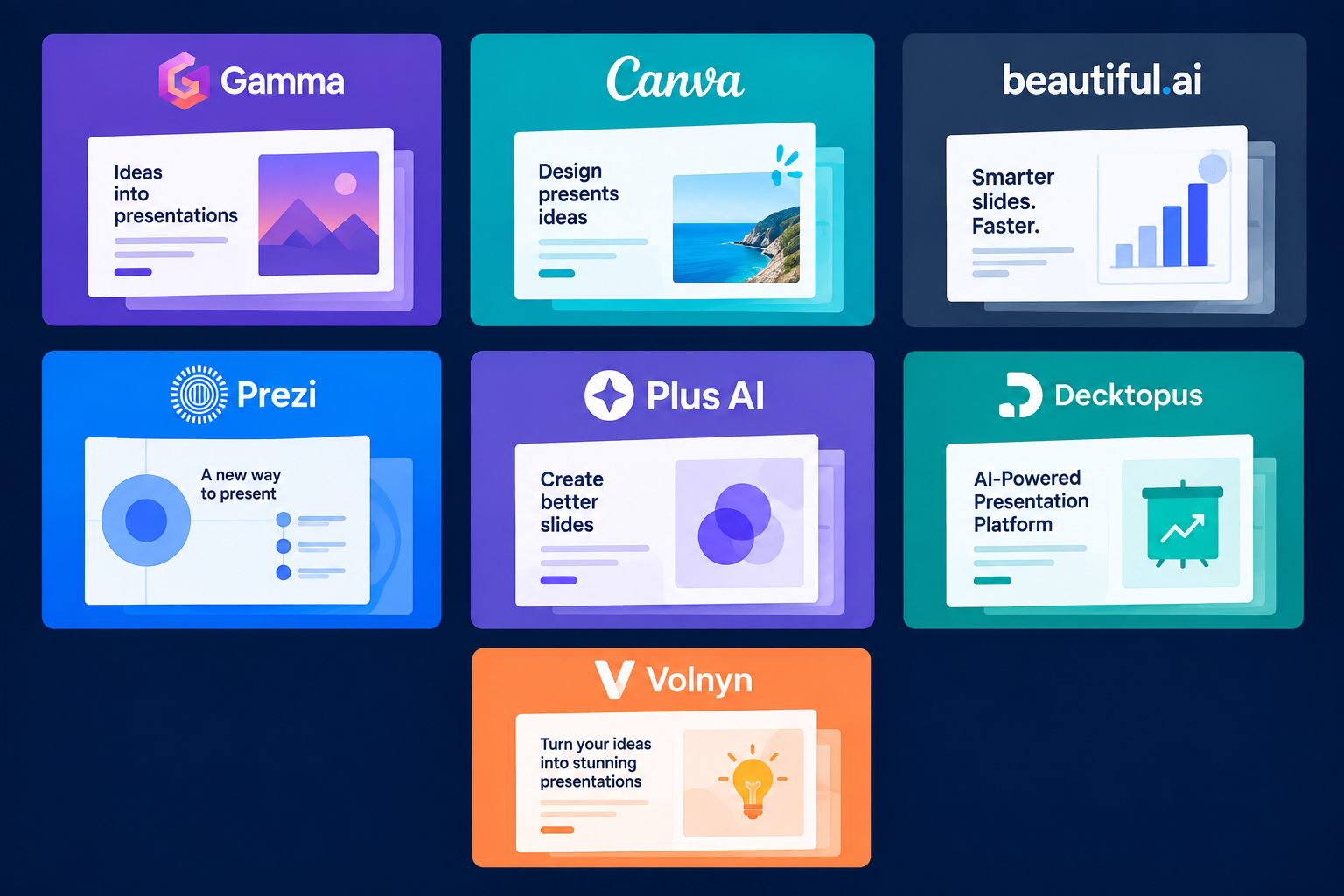
Gamma
Gamma is popular for fast, visually modern decks that feel native to the web — good for internal updates or async sharing where a browser link is fine. Its PPTX export has historically been the weaker part of the workflow, so it's worth double-checking export fidelity if the deck needs to leave the Gamma ecosystem.
Canva (AI Presentations)
If your team already lives in Canva for other design work, its AI presentation feature is a natural extension — strong template and brand-asset library, solid collaboration. It's less "pure AI drafting" and more "AI-assisted design," which is a plus if you want more manual control over the outcome.
Beautiful.ai
Built around automated, always-aligned layouts — good for people who don't want to think about design at all. Some customization (like custom fonts) tends to sit behind higher-tier plans, so check the free/entry plan carefully if brand-matching matters to you.
Prezi
Prezi's dynamic, zooming-canvas format is genuinely different from a slide-by-slide deck, and it can make presentations more memorable for certain audiences. It's a better fit for presenter-led talks than for decks meant to be read as a static document.
Plus AI
Aimed at people who want AI drafting inside a familiar tool rather than a brand-new app — worth a look if your team is committed to Google Slides or PowerPoint and just wants AI to speed up the first draft.
Decktopus
Positioned toward quick, guided deck creation with less of a learning curve — a reasonable pick if you want structure and prompts rather than a blank generation box.
Volnyn AI Slides
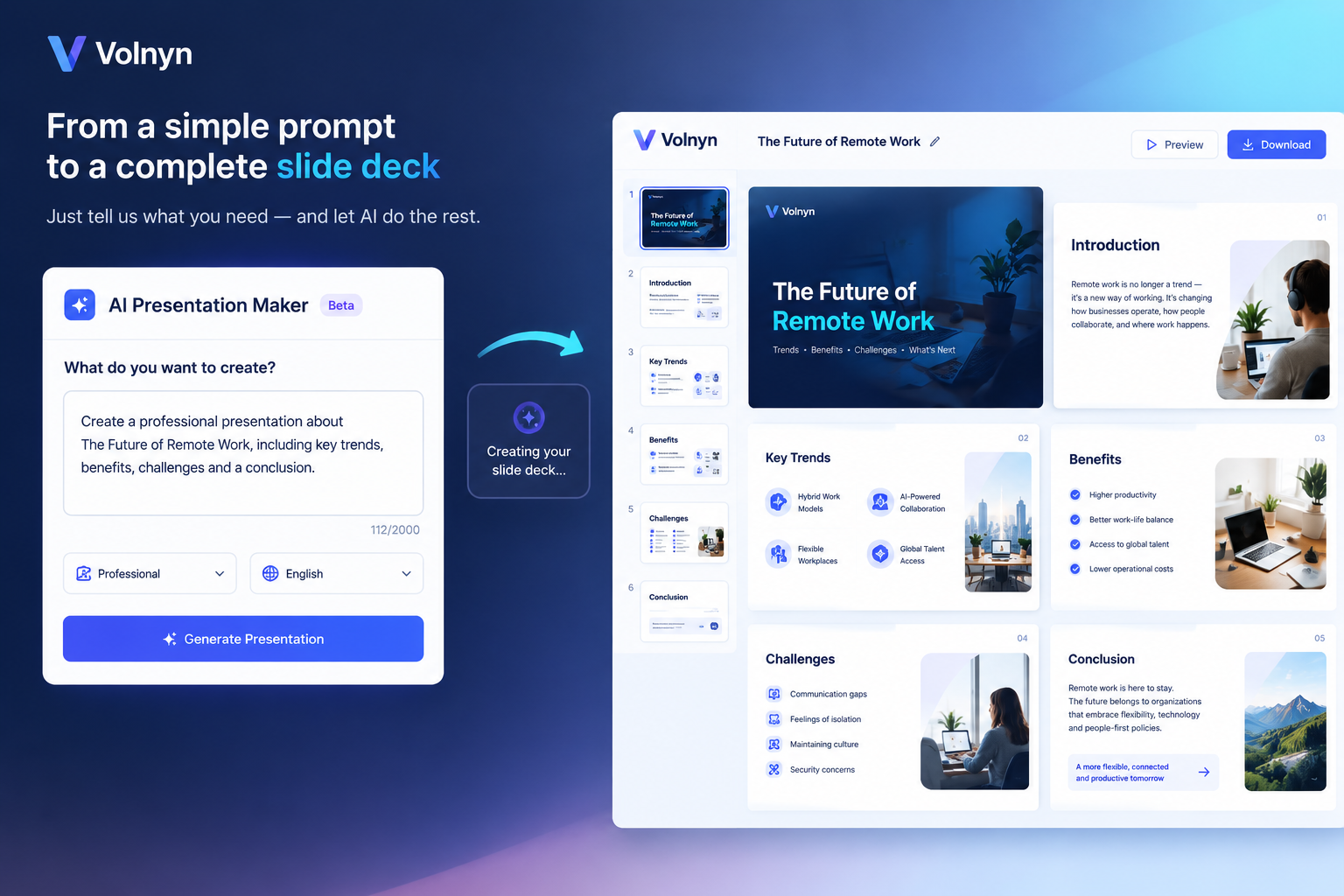
Volnyn's presentation tool generates a full deck — structure, slide content, and design — from a plain-language description, and every slide is editable afterward in a built-in editor. It's free to start with no credit card required, and it sits inside the same account as Volnyn's website builder, spreadsheet, and image/video tools, so a pitch deck and the landing page that supports it can come from one project instead of two separate apps.
Where it fits: if you want to go from an idea to a first-draft deck fast, and you might also need a website, one-pager, or supporting visuals for the same project, having them in one account removes a real amount of tool-switching friction.
Where it may not be the right fit: if your priority is a specific advanced feature — Prezi's zooming canvas, or Canva's deep brand-kit system, for example — a specialist tool built around that one feature may still serve you better. See the full walkthrough of Volnyn's AI presentation maker →
Comparison at a Glance
Tool | Best For | Free Tier | Export Focus |
|---|
Gamma | Web-native internal decks | Yes, limited | Web-first; check PPTX fidelity |
Canva | Teams already using Canva | Yes, limited | Strong design export |
Beautiful.ai | Automated, no-design-thinking layouts | Yes, limited | PPTX supported |
Prezi | Memorable, presenter-led talks | Yes, limited | Zooming canvas format |
Plus AI | AI drafting inside Slides/PowerPoint | Trial-based | Native to Slides/PowerPoint |
Decktopus | Guided, quick deck creation | Yes, limited | PPTX/PDF supported |
Volnyn | Fast first drafts + an all-in-one AI workspace | Yes, no card required | PDF/PPTX export options |
Pricing and exact free-tier limits change frequently across this category — verify current details on each vendor's site before deciding.
Which One Should You Use?
Solo founder needing an investor deck fast: Volnyn or Gamma — describe the pitch, get a structured first draft, refine the story yourself.
Marketing team already inside Canva: stick with Canva's AI Presentations rather than adding another tool.
Sales team presenting live to a room: Prezi's format is built for that kind of memorability.
Anyone whose final deliverable has to be a clean PowerPoint file for someone else's laptop: test the export in each tool before you standardize on one — this is the single most common disappointment in this category.
Is There a Genuinely Free AI Presentation Maker?
Several tools — including Volnyn, Canva, Gamma, and Beautiful.ai — let you generate a complete first deck without paying. "Free" almost always comes with a limit somewhere: slide count, watermarking, or export restrictions on the free tier. Read the specific plan page before assuming "free" means "free with no strings" — it varies more than most comparison articles admit.
Limitations to Keep in Mind
No AI presentation maker replaces judgment about your actual audience. Every tool here writes a reasonable structure, but the AI doesn't know which single point matters most to the people in the room — that edit is still yours to make. Similarly, export fidelity, brand-locking, and collaboration depth vary enough between tools that the "best" one genuinely depends on your workflow, not just which tool ranks highest.
Frequently Asked Questions
What is an AI presentation maker? It's a tool that generates a complete slide deck — structure, written content, and visual design — from a text prompt, instead of requiring you to build each slide manually.
What is the best AI presentation maker? There isn't one universal answer — it depends on whether you need a real PPTX export, deep brand control, a presenter-led format like Prezi's, or an all-in-one workspace like Volnyn. The comparison table above matches tools to common scenarios.
Is there a free AI presentation maker? Yes — Volnyn, Canva, Gamma, and Beautiful.ai all offer usable free tiers, though each caps something different (slides, exports, or branding). Check the current plan details before you build a workflow around a "free forever" assumption.
Can AI turn a document or notes into a presentation? Yes, most tools in this category — including Volnyn — accept pasted notes, outlines, or documents and convert them into structured slides while keeping your original points.
How is this different from just using PowerPoint or Google Slides? Traditional tools give you a blank canvas you build up manually. AI presentation makers generate a complete first draft — structure, text, and design — so your starting point is a finished deck you refine, not an empty one you build from scratch.
Final Recommendation
If you want to test the category with zero commitment, start with a tool that has a genuinely free first draft — Volnyn's AI presentation maker is a reasonable place to start, especially if you may also need a website or supporting visuals from the same project. If your priority is one specific strength — export fidelity, brand-kit depth, or a presenter-led format — match that priority against the comparison table above before you commit.