A marketing agency website has one job that matters more than looking impressive: helping the right prospects understand what you do, trust your expertise, and take the next step. That means an agency site needs more than attractive visuals. It needs clear positioning, focused service pages, credible proof, useful content, and a conversion path that is easy to follow.This guide explains how to build a marketing agency website from the ground up, including what pages to create, what each page should accomplish, and how to make the site useful for both visitors and search engines.
1. Define What Your Agency Is Known For
Before choosing colors, templates, or layouts, define the agency's position. “Full-service marketing agency” tells a prospect very little. A stronger position explains who you help, what you help them achieve, and how your agency approaches the problem.
For example, an agency might specialize in paid acquisition for SaaS companies, local SEO for service businesses, content marketing for B2B brands, or social campaigns for ecommerce companies.
This positioning should influence the entire website. Your headline, services, case studies, examples, and calls to action should all reinforce the same idea.
2. Build a Website Structure Around the Buying Journey
A marketing agency usually does not need dozens of pages at launch. It needs the right pages in the right order.
| Page |
Primary Purpose |
| Home |
Explain the agency's positioning and direct visitors toward the next step |
| Services |
Explain what the agency does and who each service is for |
| Case Studies |
Show evidence of expertise and outcomes |
| About |
Give prospects confidence in the people behind the agency |
| Blog or Resources |
Answer relevant questions and demonstrate subject expertise |
| Contact |
Make it easy for qualified prospects to start a conversation |
The exact structure should depend on the agency. A specialist with three closely related services may need fewer pages than a larger agency serving several industries.
3. Make the Homepage Explain the Value Quickly
The homepage should answer three questions quickly: What do you do? Who do you do it for? Why should someone trust you?
A useful homepage structure might begin with a specific headline, a short explanation, and one primary call to action. Follow that with the agency's main services, selected results or case studies, client or industry experience, a concise explanation of the process, and another clear conversion point.
Avoid filling the first screen with vague phrases such as “unlock your brand's potential.” Replace them with language that tells the visitor what the agency actually delivers.
For example, “Paid search campaigns for B2B software companies” is immediately easier to understand than “Next-generation digital growth solutions.”
4. Turn Services Into Useful Landing Pages
If search visibility and qualified leads matter, do not hide every service inside one generic services page. Give important services their own focused pages when there is enough useful information to justify them.
A strong service page can explain:
- What the service includes
- Who it is designed for
- What problems it addresses
- How the agency approaches the work
- What the engagement typically involves
- Relevant examples or case studies
- What a prospective client should do next
This also creates clearer opportunities to target specific searches. Google recommends creating helpful, people-first content and using words that people would actually use to find the information they need. Google's Search Essentials provides further guidance on these fundamentals.
5. Use Case Studies as Evidence, Not Decoration
For a marketing agency, a portfolio of attractive images is not always enough. Prospects want evidence that the agency understands business problems and can execute against them.
A useful case study can follow a simple structure:
- Describe the client's situation or challenge.
- Explain the strategy or approach.
- Show what work was delivered.
- Present measurable results when those results can be accurately documented.
- Explain what the experience demonstrates about the agency.
Do not invent performance figures to make a case study sound impressive. If exact numbers cannot be shared, describe the work and outcome honestly without implying results that cannot be verified.
6. Design the Site Around One Primary Conversion
Many agency websites create too many competing choices: book a call, download a guide, view services, subscribe to a newsletter, follow social accounts, request pricing, and send an email. The result can be less clarity rather than more engagement.
Choose the primary action that represents the next meaningful step for your business. That might be Book a consultation, Request a proposal, or Talk to the team.
Repeat that action naturally throughout the site, while keeping secondary options available for visitors who are still researching.
7. Build SEO Into the Website From the Start
SEO should not mean filling pages with repeated keywords. Start with the services and questions your prospective clients actually search for, then create useful pages that address those needs.
Give every important page a descriptive title, a clear main heading, useful supporting content, and relevant internal links. Keep URLs and navigation understandable, and make sure important pages can be reached through crawlable links.
Google also recommends paying attention to the overall page experience, including mobile usability, secure delivery, Core Web Vitals, and avoiding intrusive elements that interfere with the main content. Google's page-experience guidance explains these considerations in more detail.
If the agency serves a specific geographic market, make its location and service area clear where relevant. Google also provides guidance for establishing business details and using appropriate structured data for eligible businesses.
8. Make the Site Easy to Update
Marketing agencies change. Services evolve, team members join, case studies accumulate, and positioning becomes more focused. A website should make those changes manageable rather than turning every small update into a development project.
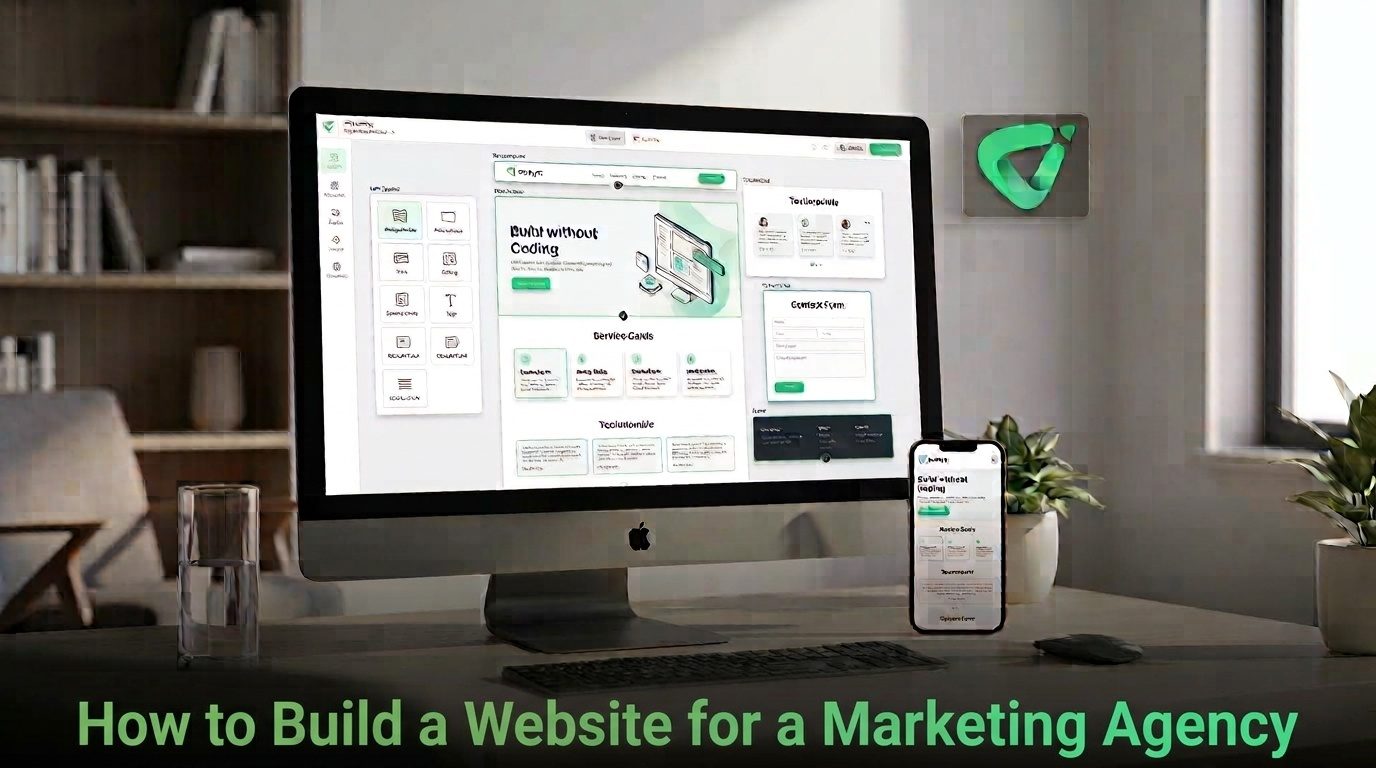
This is one reason an AI website builder can be useful for an agency that wants to move quickly. Volnyn's current AI Website Builder lets users describe a business, generate a website structure and initial content, customize the result visually, connect a domain, and publish. Volnyn also currently offers agency-oriented templates and business website layouts.
The important point is to treat AI-generated content as a starting point. Replace generic copy with the agency's actual positioning, services, examples, brand assets, and verified information before publishing.
9. Test the Website Before Launch
Before sending prospects to the new site, run through the experience as if you were a potential client.
- Can a first-time visitor understand the agency in a few seconds?
- Are the main services easy to find?
- Does every important service have enough useful information?
- Can visitors see credible evidence of the agency's work?
- Is the primary call to action obvious?
- Do forms, email links, and other important actions work?
- Does the site remain easy to use on a phone?
- Are titles, headings, links, images, and contact details accurate?
Check the site manually on different screen sizes before launch. A polished desktop design does not automatically make a good mobile experience.
Build the Website Around the Client, Not the Agency
The strongest marketing agency websites are not simply showcases of design ability. They help potential clients answer the questions that affect a buying decision: Can this agency solve my problem? Do they understand businesses like mine? Can they show evidence? What happens if I contact them?
Start with those questions, then build the pages, content, design, SEO, and calls to action around them.
If you want to create the first version without starting from a blank canvas, Volnyn's AI Website Builder can generate a professional business website from a natural-language description and give you a customizable starting point. You can then replace the initial content with your agency's real services, proof, branding, and conversion strategy.
A good agency website does not need to be complicated. It needs to be specific, credible, easy to navigate, and built around the people you want to hire you.