Managing one website is straightforward. Managing five, ten, or more can turn into a very different problem: separate logins, hosting accounts, content systems, analytics properties, domains, design tools, and maintenance routines. The websites themselves may be easy to build, but keeping everything organized becomes the real challenge.The solution is not necessarily to eliminate every tool. It is to centralize the parts of website management that are repetitive while keeping each site independent where it needs to be. This guide explains how to build a multi-website workflow that is easier to operate as your portfolio grows.
Why Multiple Websites Become Difficult to Manage
Every additional website introduces another set of recurring responsibilities. You may need to update pages, review forms, check domains, publish content, monitor performance, maintain branding, and keep project information current.
Even analytics platforms reflect this complexity. Google Analytics organizes websites and apps through accounts, properties, and data streams, allowing organizations to structure multiple digital properties under a broader account hierarchy. G Google Help
The problem is usually not the number of websites by itself. It is the number of disconnected workflows surrounding them.
- Separate website-building or CMS logins
- Different places for content and brand assets
- Repeated setup work for every new website
- Separate analytics and reporting workflows
- Different maintenance routines and documentation
- Multiple subscriptions that perform overlapping jobs
Once these tasks multiply, a centralized operating system becomes more valuable than simply adding another specialist tool.
Start by Separating What Must Be Unique
Before consolidating your tools, decide what should remain different from site to site.
A restaurant website, a real estate site, and a consulting firm's website may need completely different content, navigation, imagery, and conversion goals. Trying to make every website identical can create a poor user experience.
Instead, standardize the process behind the websites.
- Use a consistent naming system for projects and domains.
- Keep a central record of important website information.
- Create repeatable launch and maintenance checklists.
- Standardize core brand assets where appropriate.
- Use templates for recurring page types and content structures.
- Keep site-specific content and settings clearly separated.
This gives you consistency without forcing every website to look or behave the same way.
Choose a Platform That Supports Multiple Sites
If you expect to build several websites, platform architecture should be part of the decision from the beginning. Look for a system that reduces repeated account switching and lets you move between projects without rebuilding your workflow each time.
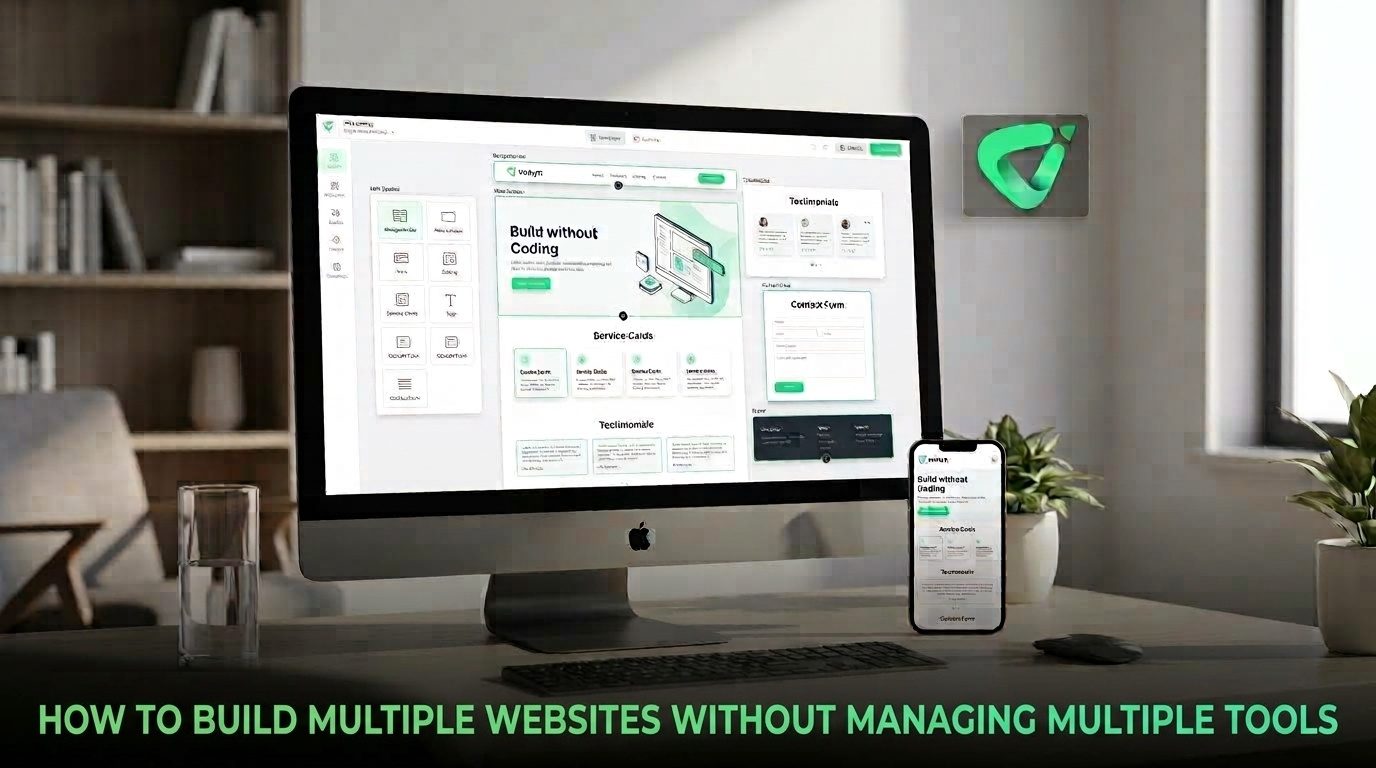
Volnyn now supports multi-site accounts and current-site switching, allowing multiple sites to exist under one account while retaining their own themes, plugins, and settings. Its May 2026 platform update also notes support for different URL configurations, including subdomains, paths, custom domains, and site slugs. V Volnyn
That distinction matters. Centralization does not have to mean combining every website into one indistinguishable project. The goal is to centralize management while keeping individual websites independent.
For teams and solo operators, this can be a more practical approach than maintaining a separate platform and login for every new project.
Use AI to Reduce Repetitive Website Setup
Creating multiple websites becomes much easier when the initial production work is repeatable. Instead of starting every project from a blank editor, define the business, audience, purpose, pages, and visual direction, then use those inputs to generate a strong starting point.
Volnyn's AI Website Builder can generate a website from a description, including its structure, content, and design. The platform also provides hundreds of templates and a visual editor for customization. VVolnyn
This is particularly useful when websites follow recognizable patterns. An agency might repeatedly create sites for local businesses. A freelancer might maintain several portfolio and service websites. A company might need separate sites for different brands or campaigns.
The important principle is to treat AI generation as a starting workflow, not a substitute for review. Each site still needs accurate business information, appropriate content, correct links, and a clear conversion path.
Keep Content and Business Information Organized
Multi-site management becomes harder when the same business information is stored in several unrelated places. A phone number, service description, company bio, pricing detail, or brand statement may eventually appear on a website, presentation, document, and marketing asset.
Centralizing the source information reduces unnecessary copy-and-paste work.
Volnyn's all-in-one workspace brings website creation, site documents, and AI presentations into the same account. Its current product description emphasizes keeping business information and branding together so that updates can be reused across related work. VVolnyn
For multiple websites, this creates a useful operating principle: store reusable information once, then adapt it for each site's audience.
Build a Simple Multi-Website Operating System
You do not need a complicated management framework. A small system can prevent most of the chaos.
- Create a site inventory. Record every domain, purpose, owner, platform, key integrations, and important renewal information.
- Define a standard launch checklist. Include domain setup, navigation, contact details, forms, analytics, SEO basics, mobile review, and final content checks.
- Create reusable templates. Keep standard structures for common pages such as About, Services, Contact, FAQs, and landing pages.
- Centralize recurring information. Maintain approved business descriptions, brand assets, contact details, and other information that appears across projects.
- Schedule maintenance. Review websites on a predictable cycle instead of waiting for problems to appear.
- Review performance separately. Central management does not mean treating every site's metrics as identical. Each website should still have goals appropriate to its audience and business model.
Analytics platforms can support this structure without requiring a completely separate organization for every website. Google explains that an Analytics account can contain multiple properties, while permissions can be managed at different levels. GGoogle Help+1
What to Centralize vs. What to Keep Separate
| Management Area |
Centralize |
Keep Site-Specific |
| Accounts |
Primary login and project access |
Individual site permissions when needed |
| Brand assets |
Approved logos, colors, and core guidelines |
Campaign-specific creative |
| Content |
Reusable business information and templates |
Audience-specific copy |
| Analytics |
Reporting process and naming conventions |
Each site's goals and performance data |
| Maintenance |
Checklists and review schedules |
Site-specific fixes and requirements |
This balance is important because excessive centralization can create its own problems. A shared workflow should make websites easier to manage, not make them less useful to their individual audiences.
When One Workspace Makes the Most Sense
A centralized approach is especially useful when you are an agency managing client sites, a freelancer running several projects, a company operating multiple brands, or an entrepreneur testing several business ideas.
It can also help when your websites are connected to the same broader workflow. If you are repeatedly moving between a website builder, document editor, presentation tool, and other creation tools, consolidating some of those activities can reduce context switching.
Volnyn is designed around this broader model: its current platform combines AI website creation with other creation tools in one account, while its multi-site capability provides a way to manage separate website projects without treating every project as an entirely separate workspace. VVolnyn+1
Common Mistakes to Avoid
Building multiple websites does not automatically require a large technology stack. In fact, adding more tools can make the operation harder to control.
- Do not create a new account for every small project unless separation is genuinely necessary.
- Do not duplicate information manually when a central source can provide the approved version.
- Do not use identical content across different websites simply because it is convenient. Adapt content to each site's purpose and audience.
- Do not ignore maintenance because a site is small. Small sites can still contain outdated information, broken forms, or expired domains.
- Do not centralize everything blindly. Keep analytics, content, permissions, and branding flexible enough to reflect each site's actual purpose.
Conclusion
The easiest way to manage multiple websites is not to pretend they are one website. It is to make the workflow around them feel like one system.
Centralize accounts, reusable information, templates, documentation, and recurring processes. Keep each site's content, audience, branding, analytics, and business goals independent where necessary. Then use a platform that supports multiple projects without forcing you to rebuild your management process every time.
If you are starting a portfolio of sites, Volnyn's AI Website Builder can help with the creation side, while its multi-site capabilities and all-in-one workspace are designed to reduce the need to jump between disconnected tools. The result is a simpler setup that can grow with the number of websites you operate.
Be the first to leave a comment.