Launching a new business does not require waiting weeks for a website. If the business is ready to explain what it offers, who it serves, and how customers can get in touch, a focused one-day website sprint can produce a credible first version that is ready to publish.The key is to avoid treating launch day as a design experiment. Decide what the site needs before you start, build only the essentials, review every important detail, and leave non-essential improvements for later.
What You Need Before You Start
The fastest website projects are usually the ones with the least uncertainty. Before opening a website builder, collect the information that will drive the site.
- Business name and short description
- Primary products or services
- Target customer or audience
- Service area or business location, if relevant
- Phone number, email address, and other contact details
- Logo, brand colors, and usable photographs
- Domain name, if you already own one
- One clear action you want visitors to take
You do not need perfect copy or a complete marketing strategy. You need enough accurate information to explain the business clearly.
Use a Simple One-Day Website Plan
A one-day launch becomes much more realistic when you divide the work into focused stages rather than trying to perfect everything simultaneously.
| Time |
Focus |
Goal |
| 9:00–10:00 |
Plan |
Define the audience, offer, pages, and main call-to-action |
| 10:00–12:00 |
Build |
Create the core pages and initial design |
| 12:00–2:00 |
Content |
Replace generic copy and imagery with real business information |
| 2:00–4:00 |
Refine |
Improve navigation, mobile presentation, calls to action, and trust signals |
| 4:00–5:00 |
Test |
Check links, forms, spelling, contact details, and mobile layouts |
| 5:00–6:00 |
Launch |
Connect the domain, publish, and verify the live website |
The exact timing is flexible. The important principle is to give each stage a defined purpose and stop polishing one area before the fundamentals are finished.
Build Only the Pages Your New Business Needs
A new business rarely needs a huge website on its first day. Start with the pages that answer the questions a potential customer is most likely to have.
Homepage
Explain what the business does, who it helps, where it operates if location matters, and what visitors should do next. The main headline should communicate the offer rather than simply saying “Welcome.”
Services or Products
Describe what customers can actually buy. Keep each description specific and useful. If prices, packages, product specifications, or starting prices are available, include them where appropriate.
About
Use this page to establish credibility. Explain the business, its experience, approach, team, or reason for existing. Keep the focus on information that helps a prospective customer decide whether to trust you.
Contact
Make the next step obvious. Include the appropriate phone number, email address, location, service area, contact form, booking option, or other method of reaching the business.
Add additional pages only when they solve a real customer need. A portfolio, FAQ, individual service pages, booking page, blog, or online store can be added when the business actually benefits from them.
Use AI to Speed Up the First Draft
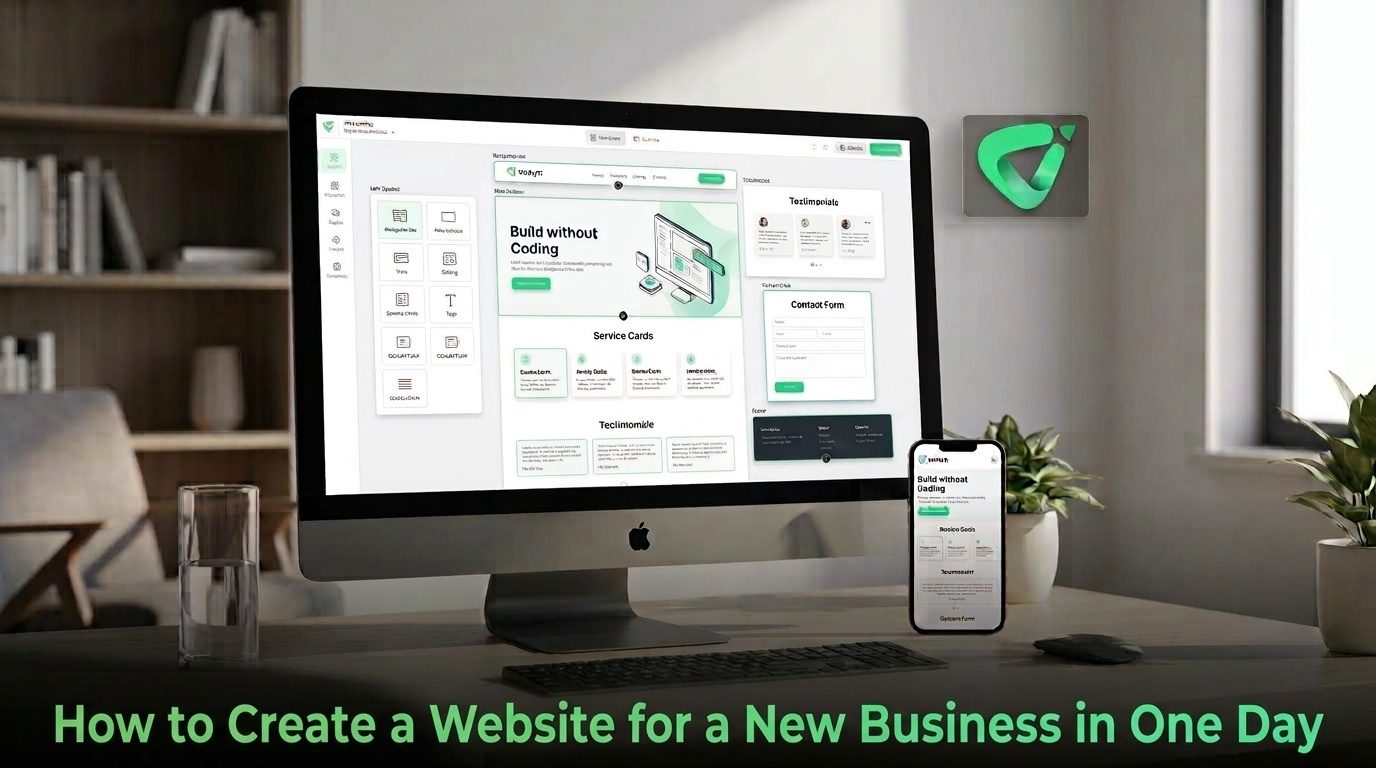
The biggest time-saving opportunity is often getting past the blank page. Volnyn's AI website builder lets you describe the business and generates a website structure, content, and design as a starting point. Its current builder also offers templates, visual customization, domain connection, and mobile-responsive layouts.
The important word is starting point. AI-generated content should be reviewed before publication. Replace vague claims with facts, correct business details, add real photographs where they matter, and make sure the tone sounds like the actual company.
A useful prompt is more specific than “make me a business website.” Explain the business, audience, location, products or services, desired tone, and primary customer action. The more useful information you provide, the less time you should spend correcting assumptions later.
Do a Pre-Launch Check Before Publishing
Speed should not mean skipping quality control. A website can look finished while still containing embarrassing or costly mistakes.
- Read every page for spelling, grammar, and inaccurate claims.
- Check the business name, phone number, email address, location, and opening hours.
- Click every important navigation link and call-to-action.
- Submit contact forms and confirm that they work as expected.
- Review the website on a phone as well as a desktop screen.
- Check that important pages have clear titles and descriptions.
- Remove placeholder text, stock content, and unfinished sections.
- Confirm that the domain points to the correct published website.
Basic SEO is part of launch hygiene, not a reason to delay publication. Google recommends creating clear, useful pages that are easy for both users and search engines to understand. Its SEO guidance also emphasizes descriptive titles, useful links, and making sure search engines can access and understand the page.
For a local business, also consider setting up or claiming a Google Business Profile if the business is eligible. Google says eligible storefront and service-area businesses can use Business Profiles to manage information such as their website, phone number, hours, location, photos, and customer reviews.
What Can Wait Until After Launch?
One of the biggest mistakes in a one-day website project is trying to solve every future problem before the first version goes live.
You can usually postpone advanced analytics, a large blog library, extensive animations, dozens of landing pages, elaborate integrations, and highly detailed visual experimentation. Those improvements become easier to prioritize once real visitors begin using the website.
Launch with a clear foundation, then improve it based on actual customer questions and business needs. A website is not finished simply because it has been published; it becomes more useful through deliberate iteration.
A One-Day Website Should Be a Starting Line
Creating a website for a new business in one day is realistic when the goal is a focused first launch rather than a perfect final product. Prepare the business information, keep the page structure simple, use AI to accelerate the first draft, replace generic material with real details, and spend the final part of the day testing everything.
For entrepreneurs who want to move quickly without starting from an empty canvas, Volnyn's AI website builder can turn a business description into a working website starting point without requiring coding skills. You can then refine the content, design, and structure before connecting your domain and publishing.
The objective is simple: by the end of the day, your business should have a clear, credible place online that customers can actually use. Everything else can be improved from there.

Be the first to leave a comment.